A Lucid Explanation of the Ordered Pairing of Planets in Our Solar System
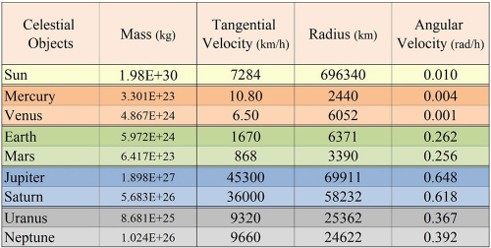
Consideration of the local Solar System reveals eight distinct and well-defined planets. Based on the data presented in the table below, an examination of the physical and observable characteristics of these celestial bodies demonstrates that they can be categorised into four binary pairs. Specifically, Venus and Mercury constitute one pair; Earth and Mars form another; Jupiter and Saturn comprise the third; and Uranus and Neptune represent the final grouping. To explore this phenomenon further, a mechanical analogy may be utilised.
If a basic seesaw mechanism is considered, the closer two objects positioned on opposing sides are in mass, the less energy is required to achieve oscillation, resulting in the smoothest possible movement. For instance, as two objects, denoted as A and B, move vertically, any increase in the mass differential between points A and B necessitates a greater input of energy to sustain the oscillatory motion, thereby inducing higher instances of abrupt mechanical shocks. Consequently, a greater disparity in mass yields increased instability and asymmetry within the system.

However, within solar systems—where the central star remains stationary and the planets orbit around it—the dynamics incorporate not only reciprocal vertical oscillation but also rotational motion. Each planet rotates simultaneously on its own axis whilst revolving around the host star.
If the planets are observed as nearly identical pairs, the equilibrium, homogeneity, and order of the system become significantly more pronounced. To elucidate this principle further, an automotive wheel balancing analogy may be applied: a vehicle wheel weighing approximately 30 kg is ultimately brought into rotational equilibrium using a lead weight of merely 30 g. In essence, the tyre and wheel rim assembly, which possesses a mass of 30,000 g, is balanced by a lead weight equivalent to approximately one-thousandth of the total wheel mass.
Consequently, the pairing of planets within the Solar System (in terms of observable physical parameters) facilitates enhanced equilibrium, order, and systemic harmony within this celestial mechanism. Therefore, it can be posited that for ideal equilibrium within a solar system, the existence of such binary pairing constitutes a necessary and sufficient condition.
References:
[1] Saleh, Gh. "A New Explanation for the Formation of Solar Systems and the Equations of Motion of Planetary in the Universe." Saleh Theory, 28 May 2026, https://saleh-theory.com/article/a-new-explanation-for-the-formation-of-solar-systems-and-the-equations-of-motion-of-planetary-in-the-universe-2026
[2] Saleh, Gh. The Reform Book: A Revolution in Modern Physics. Vol. 2, Saleh Research Centre, 2026, https://saleh-theory.com/files/article/pdf/the-reform-book-a-revolution-in-modern-physics-vol2-2026.pdf
[3] Saleh, Gh. "An Answer to the Questions Raised in the NASA Challenge (APOD) Concerning Planetary Orbital Speeds, the Axial Tilt of Uranus, and the Retrograde Rotation of Venus." Saleh Theory, 30 May 2026, https://saleh-theory.com/article/an-answer-to-the-questions-raised-in-the-nasa-challenge-apod-concerning-planetary-orbital-speeds-the-axial-tilt-of-uranus-and-the-retrograde-rotation-of-venus
[4] Saleh, Gh. The Reform Book: A Revolution in Modern Physics. Vol. 1, Saleh Research Centre, 2026, https://saleh-theory.com/files/article/pdf/the-reform-book-a-revolution-in-modern-physics-2026.pdf
 Download PDF
Articles