






logo

The Saleh Research Group is purposed to exploring the mysteries of the universe and investigating ancient knowledge to provide appropriate explanations for historical riddles.

The Book of Us

The Reform Book, A Revolution in Modern Physics 2026

New Articles Explore the new articles
NASA Challenge:

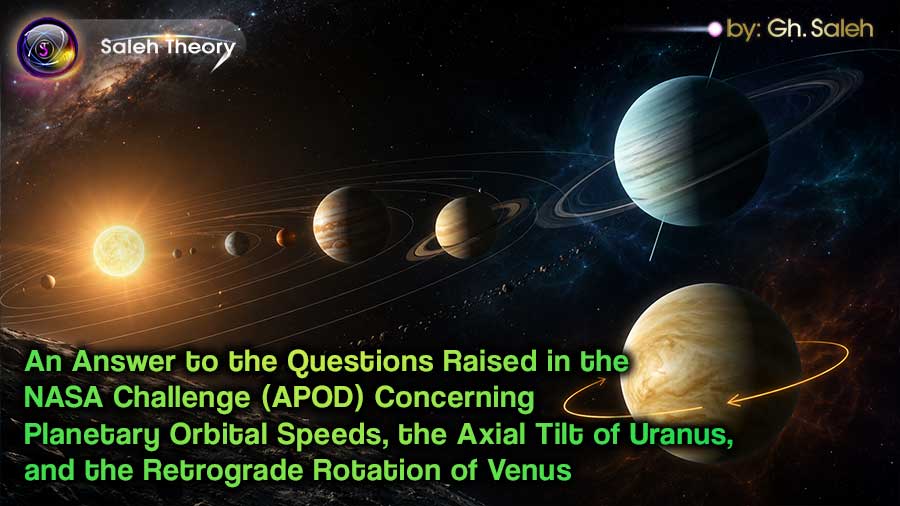
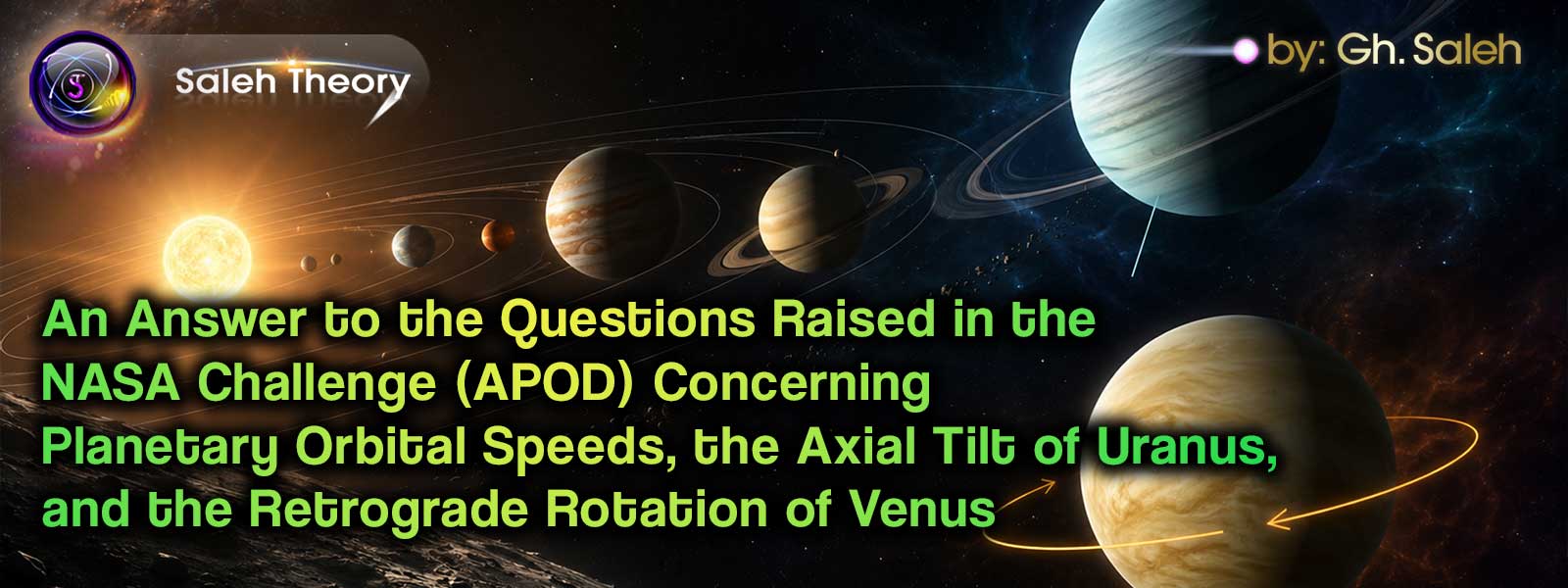
"How does your favorite planet spin? Does it spin rapidly around a nearly vertical axis, or horizontally, or backwards? The featured video animates NASA images of all eight planets in our Solar System to show them spinning side-by-side for an easy comparison. In the time-lapse video, a day on Earth -- one Earth rotation -- takes just a few seconds. Jupiter rotates the fastest, while Venus spins not only the slowest (can you see it?), but backwards. The inner rocky planets across the top underwent dramatic spin-altering collisions during the early days of the Solar System. Why planets spin and tilt as they do remains a topic of research with much insight gained from modern computer modeling and the recent discovery and analysis of hundreds of exoplanets: planets orbiting other stars."

Kindly find presented hereunder the proposed answers graciously provided by Professor Gh. Saleh in respect of the aforementioned questions

1- Why Do Planets Orbit at Their Respective Speeds?

To address this question, one must first draw attention to the fundamental nature of planetary motion within a solar system: all such motions are rotational in character. Indeed, the entire universe may be regarded as rotating universe — a planet rotates upon its own axis whilst simultaneously revolving around its central star along a curved orbital path.

As an initial point of reference, let us consider the table of angular speeds. With regard to the 6 planets beyond Mercury and Venus, it may be observed that they have an approximately equal mean angular speed (ω). This implies that the angular speeds of these 6 planets are broadly comparable. This commonality may be attributed to the rotational motion of particles within nebular dust clouds.

Why Do Planets Orbit at Their Respective Speeds?

At the time of planetary formation, this rotational motion was inherent within the constituent particles, consistent with the principle that particles have both linear and rotational motion. It may therefore be argued that the angular speed (ω) present within these particles constituted a fundamental parameter from the outset — indeed, rotation is intrinsic to the nature of the particle itself — and this motion persists throughout the process of planetary accretion.

Considering the formula v = r ω, where ω denotes the angular speed, r the planetary radius, and v the tangential speed, and given that ω is treated as the fundamental parameter, the planetary radius may vary — being larger or smaller, as illustrated by the contrast between Earth and Jupiter.

Within a solar system, the radius of a planet is determined by its mass and size, which may range considerably. In accordance with this formula, as the planetary radius increases, the tangential speed increases correspondingly. The differing tangential speeds observed amongst the aforementioned six planets — comprising Earth and those beyond it — are therefore a natural consequence of this relationship: the larger the planetary radius, the greater the tangential speed, given that ω remains approximately constant.

With respect to the first two planets, Mercury and Venus, it may readily be stated that their angular speed are closely aligned with that of the Sun. Their proximity to the Sun indicates that the combined effects of the solar magnetic force and gravitational force are such that these planets have been brought into alignment with the Sun's own rotational dynamics. To illustrate this point simply: if the mean surface temperature of Earth is taken as approximately 15°C, the mean temperatures of Mercury and Venus are of the order of 400°C.

As one approaches the star, temperature naturally rises; and as temperature increases, so too do the magnetic and gravitational effects experienced by these planets, bringing their rotational frequencies ever closer to resonance with that of the Sun itself.

2- What Is the Cause of Uranus's Axial Tilt?

If one considers experimental observations of the effects of magnetic fields upon steel balls or ferrous objects — as demonstrated in widely available recordings — it is evident that, upon varying the intensity of the magnetic field, the metallic object begins to move and may adopt orientations ranging from horizontal to vertical rotation. By analogy, the axial orientation of Uranus may be attributed to the interaction between the magnetic influence of the Sun, the gravitational and magnetic effects of the neighbouring planets, and the particular internal structure of Uranus's core. The resultant interplay of these forces gives rise to the unique axial configuration observed in Uranus. It follows that any planet placed within the same orbital region and subject to equivalent conditions would similarly adopt this orbital orientation.

3- Why does Venus rotate in the opposite direction to the other planets?

Given that every star may exert both gravitational and magnetic influences, the retrograde rotation of Venus — relative to the other planets — may be attributed to the interference, or resultant vector, of the gravitational and magnetic effects acting in conjunction. It is proposed that, for a rocky and metallic planet such as Venus, the combined outcome of these forces is such that it induces a rotational direction contrary to that observed in the remaining planets of the solar system.

Articles Categories Explore our articles by selecting the available categories
30 Articles
Optical Physics


Read Articles
61 Articles
Particle Physics

Molecule, Atom, Neutron, Proton, Electron

Read Articles
97 Articles
Astro-Physics

Gravity, Magnetism, etc.

Read Articles
22 Articles
Applied Physics


Read Articles
Saleh Theory
Saleh Theory Articles in Saleh Theory articles indexed in:
NASA/ADS Read more
Google Scholar Read more