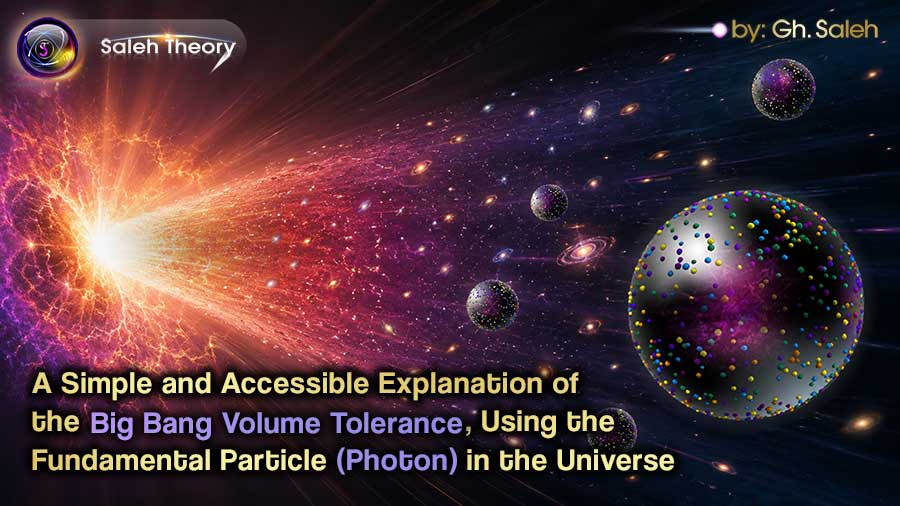
A Simple and Accessible Explanation of the Big Bang Volume Tolerance, Using the Fundamental Particle (Photon) in the Universe
If the densities of the objects around us are considered, beginning with the simplest element, hydrogen, whose density is 0.09 kg⁄m3 , or with ordinary water, found everywhere, whose density is 1000 kg/m3, through to heavy elements such as gold, at 19,300 kg⁄m3 , and on to stars, planets, white dwarfs, black holes, and so forth — each is found to possess a characteristic density.
Given that a white dwarf is composed of protons, and that its density is of the order of 1014 kg⁄m3 , it may be said that the density of the elements of the periodic table is, in comparison with the density of white dwarfs, of a micron-scale ratio.
The reason for this elevated density is that the atomic structure of the elements has broken down, with the protons drawing together to form proton stars, or white dwarfs. Denser still than the white dwarf star are black holes, whose densities lie in the region of 1020 kg⁄m3 to above 1030 kg⁄m3.
This signifies that the structure of black holes consists of broken photons, whose internal structure has disintegrated, such that primary particles, referred to as Cidtonium, come together to form denser objects.
Given that the underlying, elementary basis of protons and electrons is the photon, the breaking of photons causes the photonic structure to collapse, its internal order to disintegrate, and smaller particles, termed Cidtonium, to be produced. Indeed, it may be put thus when a star is transformed into a white dwarf, its volume becomes approximately one billionth of its original size, and its density increases a billionfold accordingly.
If this model is extended, then upon the breaking of the photon, objects of density 1020 kg⁄m3 and above will result. Indeed, it is the breaking of the photon into its constituent primary elements that gives rise to this density.
For heavier objects, the Cidtonium structure is broken down, giving rise to a primary element termed Irenium, whose density is approximately one billionth that of Cidtonium, capable of forming objects of density in the region of 1030 kg⁄m3 . Were Irenium in turn to be broken down, it would yield its own constituent elements, termed Ilitinium, giving rise to objects of density 1040 kg⁄m3.
If we want to find the constituent matter of the Big Bang, we can suggest the photon as the chosen option, as it is the smallest, lightest, and fastest particle in the universe. Considering this particle, the volume and density of the Big Bang are as follows:
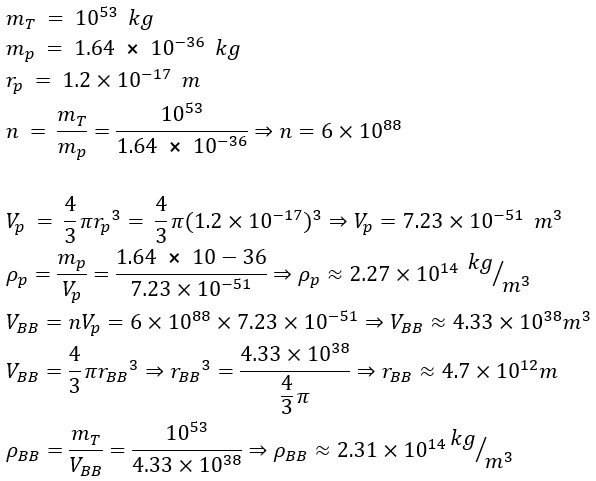
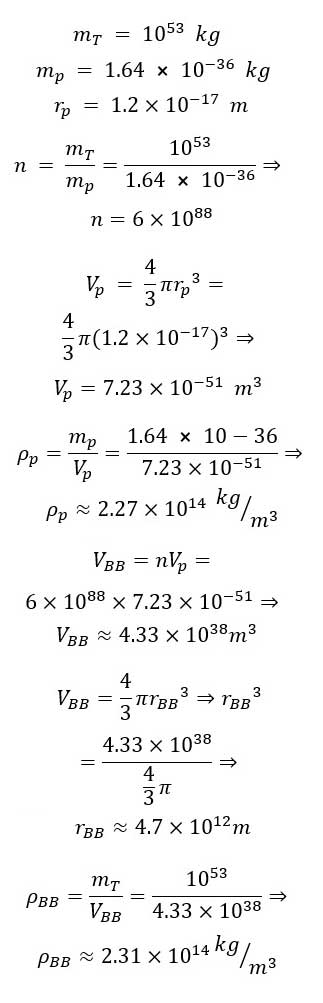
Where mT is the total mass of the universe, 𝑛 is the number of photons, mp,rp,Vp 𝑎𝑛𝑑 ρp are the mass, radius, volume and density of the photon and rBB,VBB 𝑎𝑛𝑑 ρBB are the radius, volume and density of the Big Bang sphere.
Given that the density of the Big Bang obtained using photons is not more than 1014, and the volume of the Big Bang is equal to the volume of the distance from Earth to Jupiter, therefore, the photon will not be a suitable option for the Big Bang. Because it does not fulfill the definition we expect from the Big Bang. In order to achieve our desired goal, we define a particle in the photon whose radius is one billionth of a photon, “Sub-Photon”. According to this definition, the data will be as follows:
Cidtonium with a density of 1024 to 1028 kg⁄m3 and its radius:

Irenium with a density of 1031 to 1036 kg⁄m3 and radius of:

Ilitonium with a density of 1037 to 1042 kg/m3 and the radius:

The volume of Ilitonium, or the third sub-photon, is equal to:

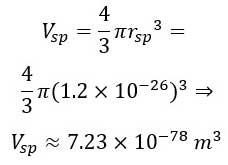
Studies have shown that the mass of Ilitonium is approximately 5 × 10⁻³ times the mass of a photon.

Now, if Ilitonium is taken to be the constituent particle of the mass of the Big Bang, to obtain the number of sub-photons that make up the mass of the Big Bang, it is enough to divide the mass of the entire universe by the mass of one sub-photon (Ilitonium), that is:
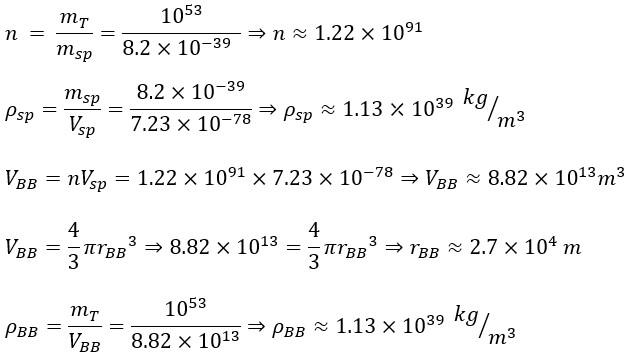
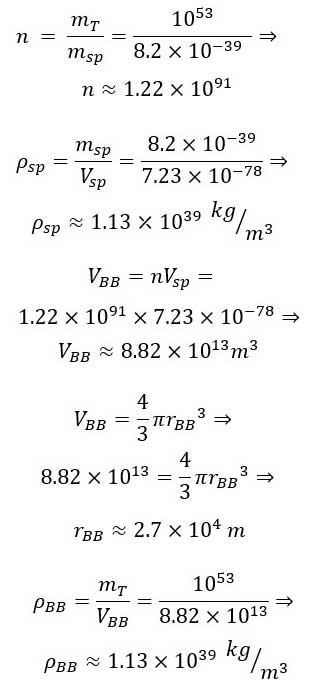
Where mT is the total mass of the universe, n is the number of Ilitonium, rsp, Vsp, ρsp are the radius, volume, and density of the sub-photon (Ilitonium), and rBB, VBB, ρBB are the radius, volume, and density of the Big Bang sphere based on the sub-photon (Ilitonium).
The density of the Big Bang is about 1039 kg⁄m3 , so this particle is a good candidate for the nature of the Big Bang, whose radius is 10-9 times the radius of a photon or whose volume is 10-27 times the volume of a photon.
Thus, in light of the sub-photon introduced and the aforementioned calculations, it becomes evident that no such thing as a Big Bang of zero volume exists.
Conclusion:
It may indeed be said that, were the mass of the universe to be concentrated at a single point, this would admit of a mathematical definition, in the sense of a point the size of a pinhead, but would admit of no physical definition; the approximate volume of the Big Bang would instead correspond to approximately the volume of the Moon.
References:
[1] Saleh, Gh. The Reform Book: A Revolution in Modern Physics. Volume Ⅱ, Saleh Research Centre, 2026, https://saleh-theory.com/files/article/pdf/the-reform-book-a-revolution-in-modern-physics-vol2-2026.pdf
[2] Saleh, Gh. "A New Discoveries Concerning Sub-Photon Particles: Cidtonium, Irenium and Ilitonium In the Universe." Saleh Theory, 06 Jan 2026, https://saleh-theory.com/article/a-new-discoveries-concerning-sub-photon-particles-cidtonium-irenium-and-ilitonium-in-the-universe
[3] Saleh, Gh. The Reform Book: A Revolution in Modern Physics. Vol. 1, Saleh Research Centre, 2026, https://saleh-theory.com/files/article/pdf/the-reform-book-a-revolution-in-modern-physics-2026.pdf
[4] Saleh, Gh. "A Clear Explanation of the Approximate Volume of the Big Bang and Its Density in the Universe." Saleh Theory, 27 Nov 2025, https://saleh-theory.com/article/a-clear-explanation-of-the-approximate-volume-of-the-big-bang-and-its-density-in-the-universe
 Download PDF
Articles