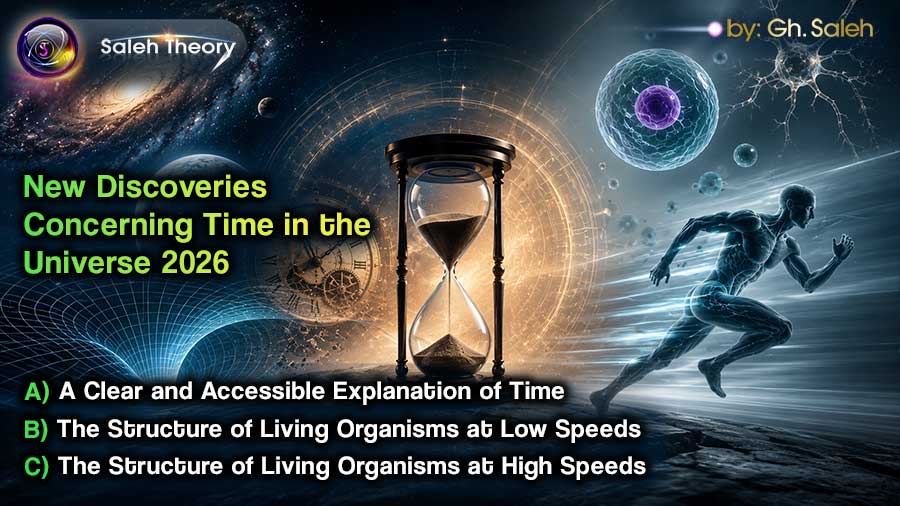
New Discoveries Concerning Time in the Universe 2026
A) A Clear and Accessible Explanation of Time
Consider a moving object travelling from point A to point B. Should it travel at a speed of 100 km/h over a distance of 100 km, it follows that the object will require precisely one hour to traverse this distance at the given speed. Should the same object — or indeed another — travel at 200 km/h, it can readily be determined that the one-hundred-kilometre distance would be covered in half an hour. Conversely, should a moving object cover this same distance at 50 km/h, the elapsed time for that object would amount to 2 hours.
Of particular note is the observation that, as the speed of a moving object increases, the elapsed time diminishes; and as the speed decreases, the elapsed time extends accordingly. In essence, provided an object is in motion, a travel time may be defined for it, and this elapsed time fluctuates in accordance with the varying states of the object in question. Should the speed of a moving object tend towards infinity, the elapsed time tends towards zero; and should the object tend towards rest, the elapsed time tends towards infinity. The varying states of moving objects therefore alter the magnitude of travel time. It may thus be concluded that time is a dependent parameter, subordinate to the moving object in question. As the speed of a moving object rises or falls, the value of time rises or falls correspondingly.
Should time itself be altered — increased or decreased — no effect whatsoever would be observed upon the speed, direction of motion, or any other state of the moving object. It may therefore be concluded that time is a dependent parameter contingent upon the motion of the object. Whilst changes in the moving object will produce changes in time, changes in time will produce no effect upon the moving object.
In celestial motions, however — such as the orbit of the Earth around the Sun and other such movements — celestial objects are necessarily in continuous motion. Their mean speed are constant, their orbits are fixed, and every parameter — whether mass or any other — remains constant and uniform. Given the temporal cycles of celestial orbits, or any other regular motion, the position of a celestial object or moving object may be predicted at specific moments in time, precisely because the orbit constitutes a closed, uniform path with consistent speed and mass. It is important to note that temporal variation within such motions enables the prediction of movement, yet exerts no influence upon the underlying structure itself.
By way of illustration, within a single day of 24 hours — conventionally divided into 12 hours of daylight and 12 hours of night — temporal subdivisions readily permit the prediction that the time 15:00 corresponds to the afternoon, whilst 6:00 corresponds to the morning; in the afternoon the sun progresses towards setting, whilst in the morning it ascends towards its zenith. In motions of this determinate character, time may serve as an aid in predicting or describing such movements. It must, however, be carefully noted that the quantity of time elapsed, past, or forthcoming exerts no influence upon these phenomena.
Similarly, in the case of a planet's annual orbit around its star, terrestrial seasons arise. For the Earth, 365 days are divided into 4 seasons, each comprising 3 months, a scheme which is grounded in the Earth's uniform motion at a constant, steady velocity. It should be observed that within predictable structures — that is, regular motions characterised by uniform speed and uniform averages — uniform predictions may be made with the passage of time. In effect, time exerts no influence upon such structures; rather, it is the motion model of the structure that lends time its precise definition.
Conclusion: Changes in a moving object will produce changes in time, but changes in time will not produce changes in a moving object. Time is a subordinate, dependent parameter that exerts no effect upon the surrounding world. Nevertheless, should a moving object exist — together with its states and changes — temporal variation will ensue.
B) The Structure of Living Organisms at Low Speeds
Given that the physical structures of living organisms are well-defined and possess their own particular rhythms, every living organism has a determinate lifespan in accordance with its structure. For insects, this may range from several days to several months; for plants, from several months to several years; for trees, from several months to several centuries; for certain animals, from several years to several decades; and for human beings, the lifespan falls below one hundred years. It may accordingly be stated that, in light of the biological structure and the manner of cellular interaction, a specific temporal range for the approximate lifespan of each organism may be defined. With reference to the closed internal system of each organism, and drawing upon empirical observation, such ranges may be determined. Time, in effect, exerts no influence upon this; it is rather the structure, mode of life, and associated models that determine whether a lifespan is short or long.
C) The Structure of Living Organisms at High Speeds
Should a train be in motion at exceedingly high speed, and should living organisms aboard it wishes to live therein, it would make no difference whether the train were travelling at 100, 1000, or 10,000 km/h; no effect would be exerted upon the structure or internal system of the living organism in question.
If the Earth itself is taken as a point of reference — upon which vast numbers of living organisms reside — it orbits the Sun at a speed of approximately 100,000 km/h. In effect, all living organisms are in motion at speeds in excess of 100,000 km/h, yet their biological structures remain wholly unaffected.
Of further note is the observation that nothing occurs without cause. Should the Milky Way galaxy be taken into consideration, the Sun travels within it at a speed of millions of kilometres per hour. Consequently, all living organism’s observable within the Milky Way are in motion at speeds of millions of kilometres per hour, yet this exerts no influence whatsoever upon the structure of living organisms.
If the universe as a whole is considered — within which the position of the observer lies at approximately two-thirds of the distance from its centre — it may be held that motion at speeds exceeding that of light is presently occurring, yet this produces no effect upon biological structure, and lifespans are neither diminished nor extended as a consequence.
It may therefore be concluded that time exerts no influence upon the universe; on the contrary, it is the universe that alters time. Of further significance is the observation that time possesses no intrinsic nature. If mass, for instance, is considered, it carries magnitude, dimension, sensory presence, and tangible effect upon the universe. Time, by contrast, is a relative, dependent parameter entirely devoid of intrinsic nature.
References:
[1] Saleh, Gh. " A New Explanation for the Existence of Ultimate Limits of Space, Mass, Time, and Speed in the Universe." Saleh Theory, 14 Jun 2025, https://saleh-theory.com/article/a-new-explanation-for-the-existence-of-ultimate-limits-of-space-mass-time-and-speed-in-the-universe
[2] Saleh, Gh. The Reform Book: A Revolution in Modern Physics. Vol. 2, Saleh Research Centre, 2026, https://saleh-theory.com/files/article/pdf/the-reform-book-a-revolution-in-modern-physics-vol2-2026.pdf
[3] Saleh, Gh. " Mass as a Primary and Time as a Dependent Parameter in Physical Systems: 7 Supporting Arguments." Saleh Theory, 18 Jul 2025, https://saleh-theory.com/article/mass-as-a-primary-and-time-as-a-dependent-parameter-in-physical-systems-7-supporting-arguments
[4] Saleh, Gh. The Reform Book: A Revolution in Modern Physics. Vol. 1, Saleh Research Centre, 2026, https://saleh-theory.com/files/article/pdf/the-reform-book-a-revolution-in-modern-physics-2026.pdf
[5] Saleh, Gh. " New Points about Time and Space. " APS April Meeting Abstracts. Vol. 2023. 2023.
 Download PDF