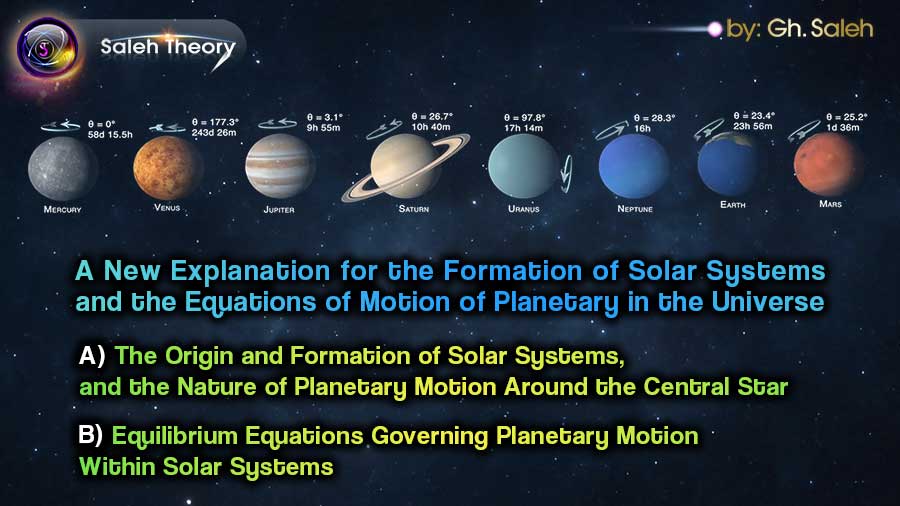
A New Explanation for the Formation of Solar Systems and the Equations of Motion of Planetary in the Universe
A) The Origin and Formation of Solar Systems, and the Nature of Planetary Motion Around the Central Star
B) Equilibrium Equations Governing Planetary Motion Within Solar Systems
A) The Origin and Formation of Solar Systems, and the Nature of Planetary Motion Around the Central Star
The origin of solar systems is traced to nebulae — regions of space characterised by an abundance of gaseous matter. Within these regions, gases gradually accumulate until conditions become sufficient to sustain hydrogen-to-hydrogen fusion reactions, thereby producing helium. This process, in essence, establishes the stellar furnace — the energy core that enables a star to emit light and radiation.
Once a central star has formed within a solar system, planetary objects are expected to form in its surrounding environment. Through the combined influence of magnetic forces, cohesive attraction, and the helical motion of particles — defined as the superposition of linear translation and intrinsic rotational motion — particles aggregate progressively, growing from the smallest scales to increasingly larger objects over time.
When considering the forces exerted by a central star upon surrounding particles, precisely two dominant forces are identified: gravitational force and magnetic force. To illustrate the relative magnitudes involved, the gravitational effect of the Sun upon an object with the mass value of one kilogram located on mars, may be calculated as follows:
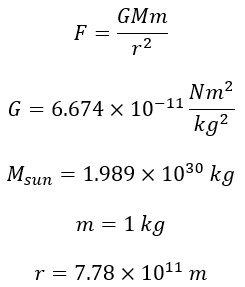

From this simple calculation, it may be concluded that the gravitational influence of a central star upon primordial particles is negligible. Only as these particles grow progressively larger — eventually forming proto-planetary objects — does gravitational force become a significant factor. Consequently, it is the magnetic force of the central star that constitutes the dominant agency acting upon primordial particles.
A fundamental point of magnetism must here be acknowledged: every magnetic field necessitates the existence of two poles. Magnetic flux, by definition, can only be established between a north pole (N) and a south pole (S). In the present context, the central star functions as magnetic poles, whilst the growing planetary object revolves around this magnet. It is proposed, therefore, that the elliptical geometry of planetary orbits is a direct consequence of the magnetic influence of the central star.
A noteworthy phenomenon arises from this configuration: as a planet — such as the Earth — approaches the central star along its orbit, its speed increases. This acceleration is attributable to the intensification of gravitational attraction at closer proximity, which in turn amplifies the rotational effect exerted by the star's own axial spin upon the planet — analogous to the motion of a hammer-throw athlete.
In this analogy, the central star imparts greater rotational speed to the planet, thereby increasing its centrifugal force. The resultant centrifugal acceleration counteracts the inward gravitational pull, preventing the planet from falling into the star and permitting the continuation of its orbital cycle.
B) Equilibrium Equations Governing Planetary Motion Within Solar Systems
Within any given solar system, a planet undergoes two simultaneous rotational motions: rotation about its own axis, and revolution about the central star. All motion within a solar system is, in essence, closed, curvilinear, continuous, and cyclically repeating. The angular speed of a planet is determined by the relation:

where v denotes the tangential speed and r the orbital radius. This relation yields the angular speed as the ratio of tangential speed to the radius of the circular path. The central star may be conceptualised as the primary axle of a celestial wave swinger, with planetary objects connected to it through gravitational linkages and perpetually revolving about it. The combined effect of the star's axial rotation and its gravitational attraction sustain the continuous and elegant orbital motion of the planets.
The angular speeds (ω) of the planets of the Solar System are presented in the following table:
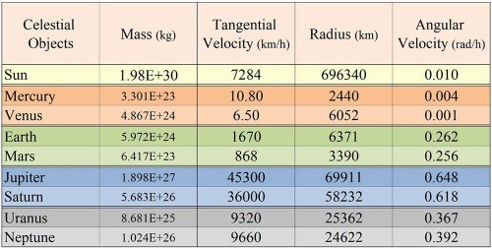
Upon examination, the angular speeds of the planets are found to be of comparable magnitude, with an approximate mean value of 0.5 (rad⁄h) applicable across all objects. This may be interpreted physically as follows: the central star, possessing a constant mass and a constant rotational speed, transmits a fixed angular speed to all gravitationally bound objects — much as a rotating axle fitted with pulleys of varying sizes imparts the same angular speed to each, whilst the tangential speed of each pulley varies in direct proportion to its radius.
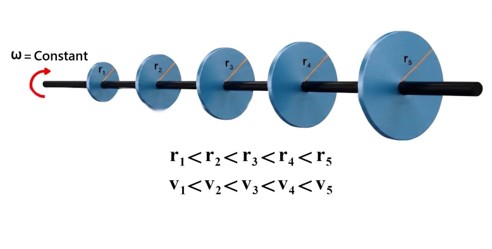
Since ω is the fundamental parameter — intrinsic to the nature of each planetary object — whilst tangential speed (v) and orbital radius (r) are variable parameters, it follows that as the orbital radius of a planet increases, so too does its tangential speed.
This provides an explanation for the observation that Jupiter's tangential speed is approximately 30 times greater than that of the Earth: as Jupiter's orbital radius is substantially larger, its tangential speed is correspondingly higher, in full accordance with the relation v=r ω.
References:
[1] O'Donoghue, James. "Planets of the Solar System: Tilts and Spins." Astronomy Picture of the Day, NASA, 14 Sep 2025, https://apod.nasa.gov/apod/ap250914.html . Accessed 28 May 2026.
[2] Saleh, Gh. " A New Explanation for the Formation, Nature, Radius, Density and Other Properties of Cosmic Inflation in the Universe." Saleh Theory, 21 Mar. 2026, https://saleh-theory.com/article/a-new-explanation-for-the-formation-nature-radius-density-and-other-properties-of-cosmic-inflation-in-the-universe
[3] Saleh, Gh. " A New Perspective on Dark Matter and Cosmic Inflation ." APS Meeting Abstracts. 2025.
 Download PDF
Articles