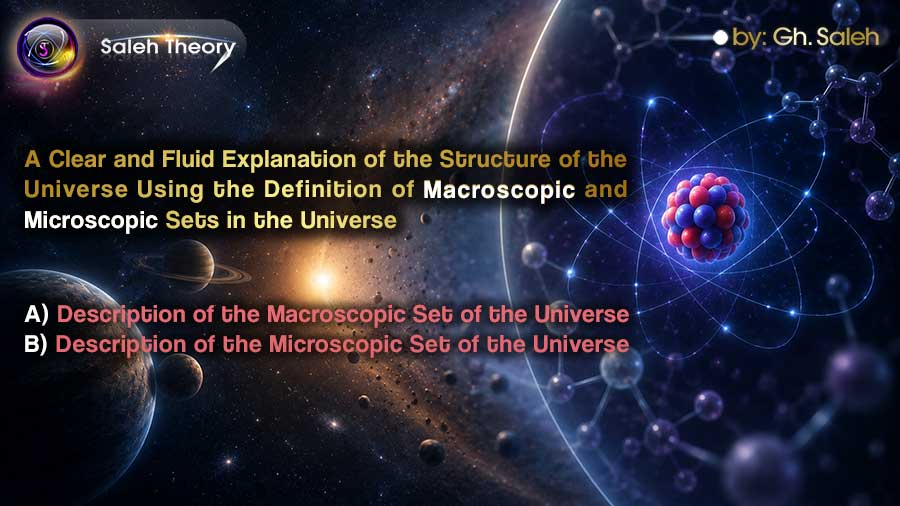
A Clear and Fluid Explanation of the Structure of the Universe Using the Definition of Macroscopic and Microscopic Sets in the Universe
A) Description of the Macroscopic Set of the Universe
Taking the universe as a whole, it is composed of superclusters, which are themselves collections of clusters gathered around one another to form those superclusters. Celestial clusters may be defined as collections of galaxies that have gathered around one another, possessing distinct structures, well-defined motional data, and specific orbital paths. Galaxies, in turn, are collections of billions of stars orbiting around their central nucleus — an enormously massive black hole with very high density. Solar systems consist of medium sized stars around which planets move, along with collections of planets and their various natural satellites— in some cases numbering in the tens — orbiting around them.
B) Description of the Microscopic Set of the Universe
Planets and moons are themselves composed of elements — more than one hundred distinct elements are currently known — and all elements possess a structure known as the atom. Atoms have a central nucleus containing protons and neutrons, with electrons orbiting around it. An atom may thus be described as a collection of fundamental particles: electrons, protons, and neutrons.
Fundamental particles, which exist in various states, are themselves made up of photons. Photons are also the building blocks of electromagnetic waves, such as radio waves, television waves, light waves, microwaves, magnetic waves, X-rays, and others. It may therefore be said that photons are the constituents of a diverse range of electromagnetic waves.
If a constituent structure is to be defined for the photon itself, the photon is composed of Cidtonium particles. These Cidtonium particles are divided into three categories — upper, lower, and middle Cidtonium — each possessing its own distinct structure.
Furthermore, given the existence of high densities on the order of 1030 kg⁄m3 , it may be proposed that Cidtonium itself could be composed of even smaller particles called Irenium, which may in turn possess still smaller constituent parts.
Taking into account densities ranging from approximately 1040 kg⁄m3 to 1050 kg⁄m3 , which exist within the universe, a particle termed Ilitonium may be derived — one capable of constituting matter at such extremely high densities.
Conclusion:
For every definition and subset within the universe — from the very largest objects to the very smallest — all such subsets and definitions are themselves composed of yet smaller collections.
References:
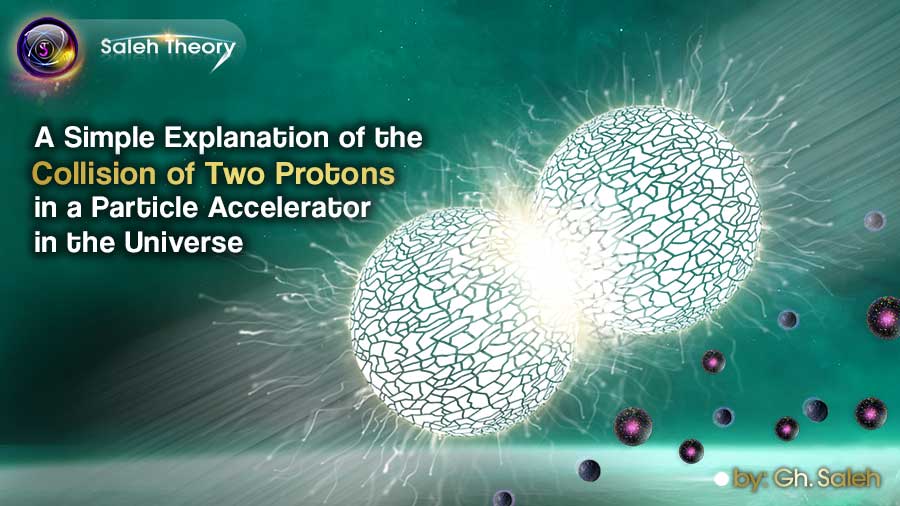
[1] Saleh, Gh. "A Simple Explanation of the Collision of Two Protons in a Particle Accelerator in the Universe." Saleh Theory, 19 May 2026, https://saleh-theory.com/article/a-simple-explanation-of-the-collision-of-two-protons-in-a-particle-accelerator-in-the-universe
[2] Saleh, Gh. "A New Discoveries Concerning Sub-Photon Particles: Cidtonium, Irenium and Ilitonium In the Universe." Saleh Theory, 06 Jan 2026, https://saleh-theory.com/article/a-new-discoveries-concerning-sub-photon-particles-cidtonium-irenium-and-ilitonium-in-the-universe
[3] Saleh, Gh. "From Macro to Micro." Saleh Theory, 17 May 2019, https://saleh-theory.com/article/from-macro-to-micro
 Download PDF