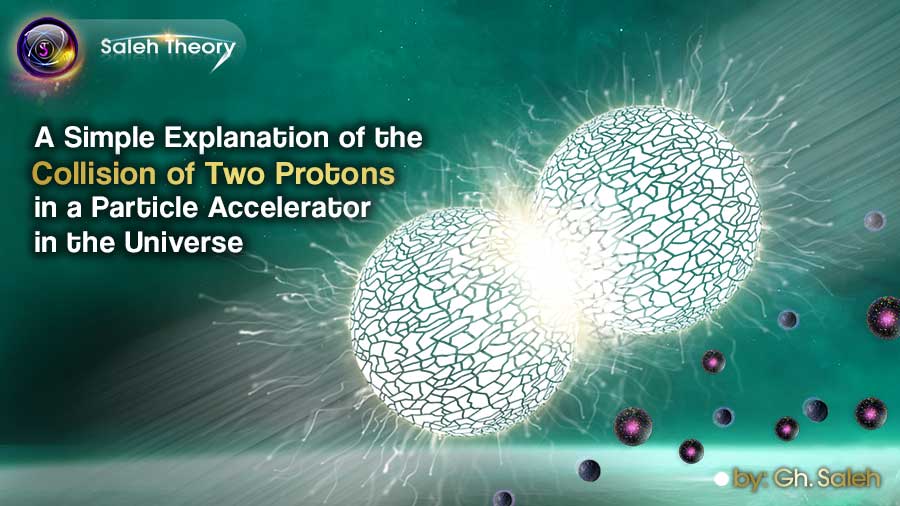
A Simple Explanation of the Collision of Two Protons in a Particle Accelerator in the Universe
Consider two billiard balls colliding at a single point. At the ordinary speeds at which players strike the balls, no visible change in the balls will be observed. However, if the speed of collision is gradually increased, the greater the speed or force of impact between the two balls, the greater the degree of fragmentation and destruction observed in the collision.
In particle accelerators, two proton particles are accelerated until they reach the required peak speed, at which point they are made to collide with one another. If two protons are regarded in the same manner as two billiard balls, the collision between their opposing surfaces — which constitute only a fraction of the total surface area of each proton — results in fragmentation.
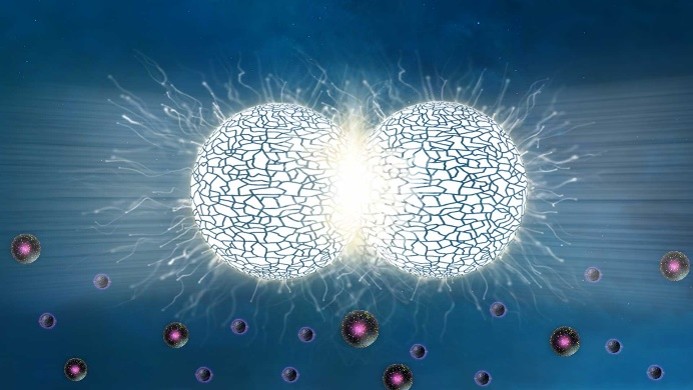
Based on the capabilities of existing accelerators, approximately %90 of each proton's volume remains intact, whilst roughly %10, in the region of direct impact, undergoes fragmentation. The effect of the impact is at its greatest at the precise point of collision, and the highest levels of energy and heat are observed at that small contact surface.
This %10 that undergoes fragmentation breaks apart into the following components:
1. A portion of the proton's own internal structure
2. Several thousand released photons
3. Certain quantities of Cidtonium
As discussed in previous texts, Cidtonium exists in three forms:
Heavy (upper)
Intermediate (middle)
Light (lower)
All these types are released as a result of this intense collision.
References:
 Download PDF