A New Explanation for the Formation, Nature, Radius, Density and Other Properties of Cosmic Inflation in the Universe
If we were to observe the era of the Universe's initial inflation, it would appear as a vast, "dusty" expanse—a huge cloud occupying a specific region of infinite space. This evolution can be divided into two distinct phases: the period before inflation and the period after.
Pre-Inflation:
During this phase, a massive collection of celestial objects with a total mass of approximately 1053 kg collided at a central point. It generated a huge gaseous cloud with a radius of roughly 1024 metres. The nature of this gas was defined by the high-velocity collision of these objects, which triggered a massive explosion. This event generated the extreme pressure, temperature, and compression required to synthesise primordial elements such as hydrogen.
This "Great Cloud" consisted of all fundamental elements, including small primordial black holes. Following the order of celestial evolution—where stars typically form before planets—primordial planets were created through the accretion of these early particles and elements.
For instance, the Solar System: Consider our Sun; if it is approximately 6 billion years old, its planets are roughly 5 billion years old. This suggests that planets form alongside their big stars, with the necessary elements present from the outset. Similarly, primordial stars possessed primordial planets, just as early galaxies contained primordial black holes. These black holes acted as gravitational anchors for stars, which in turn anchored their respective planets.
Notice: According to the Saleh Theory, every celestial object has a defined lifespan and an orbital path. Just as Earth has a "year," stars like our Sun have a galactic orbit. The Sun’s orbital period (one full revolution) is approximately 225 million years. Given the Sun's 6-billion-year age, it has completed roughly 24 full orbits since its formation.
Extending this rhythm to galaxies, we can define a "Galactic Year" as one full rotation around its annual axis. If the age of the Universe is taken as 14 billion years, and a single galactic rotation takes between 500 million to 1 billion years, then galaxies have rotated approximately 14 times. Applying this logic to the entire Universe, it is estimated to have completed roughly one-sixth of a full rotation.
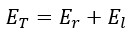
Here, Er represents rotational energy, and El represents linear energy. By utilising the definitions of linear and rotational energy, these two parameters are expressed in terms of the total mass of the universe, m = 1053 kg; the radius of rotation, r; the angular velocity (which is constant and equivalent to the Hubble constant ω = H = 2.27 × 10⁻¹⁸ s-1); and the linear speed "vl":
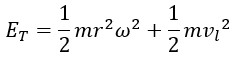
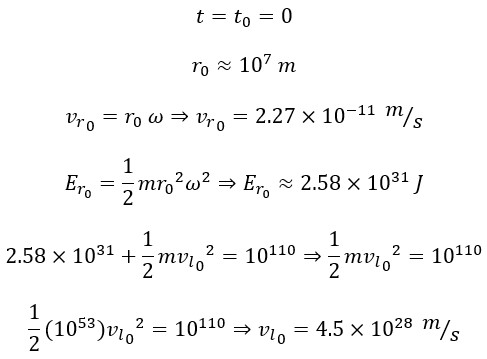
In previous articles, we have demonstrated that the universe was a spherical at the time of the Big Bang, with a size somewhere between the Earth and the Moon r 0 ≈ 10 7 m. Given the radius of the universe at the moment of the Big Bang, the contribution of rotational energy was negligible and could be ignored. Therefore, at the time of the Big Bang, the total energy can be considered to arise entirely from linear motion:
In previous article, using the density of the universe, we have calculated the radius of the universe (r1) at the end of the inflationary phase. Thus, we have:
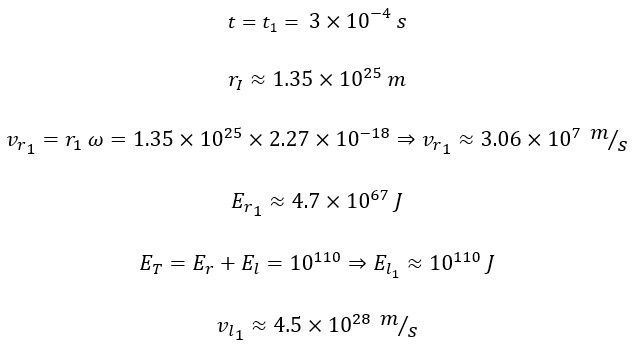
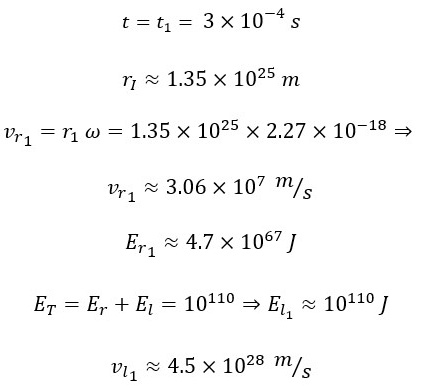
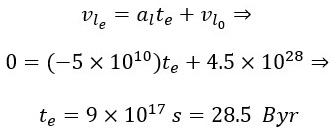
As indicated—and as discussed in previous articles—over time, the amount of linear energy decreases, and an equivalent amount is added to the rotational energy. This implies that at the end of the universe’s outward trajectory, when it reaches its maximum radius, all the energy will be converted into rotational energy, and the linear energy will reduce to zero:
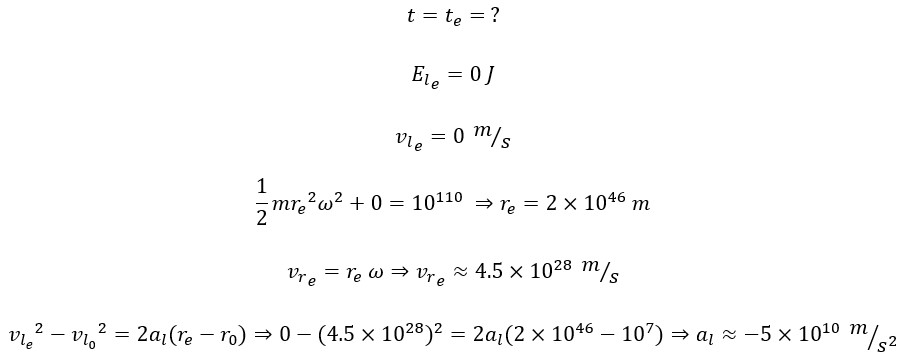
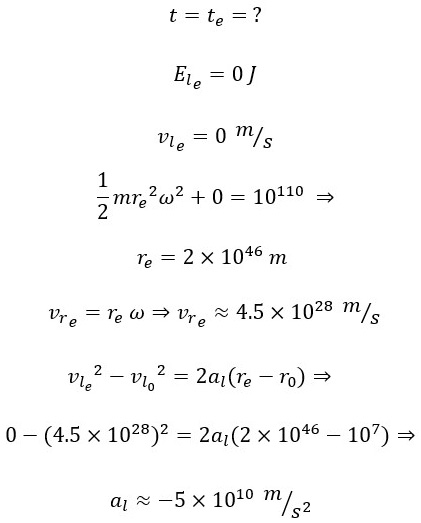
This represents the average deceleration that reduces the linear velocity (and consequently the linear energy). Thus, in linear motion, we observe a motion with constant negative acceleration.

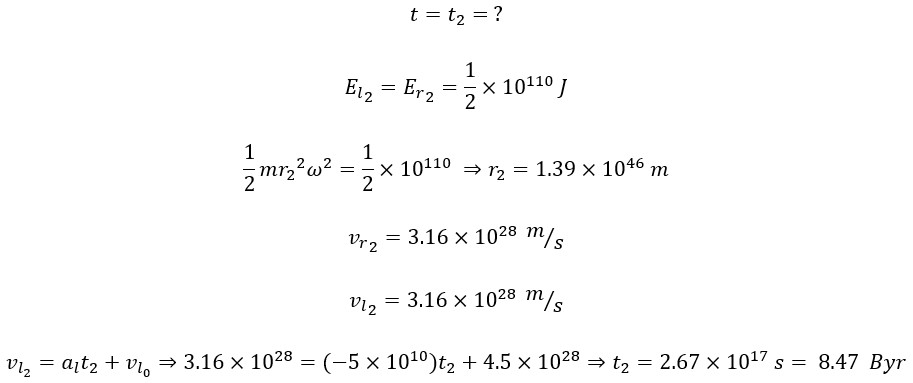
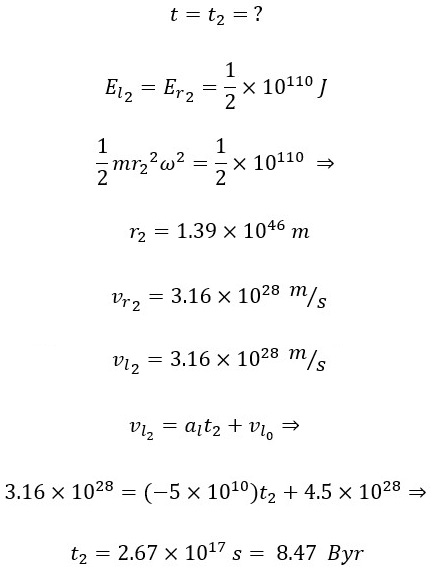
Next, we examine the time when the rotational and linear energies are equal:
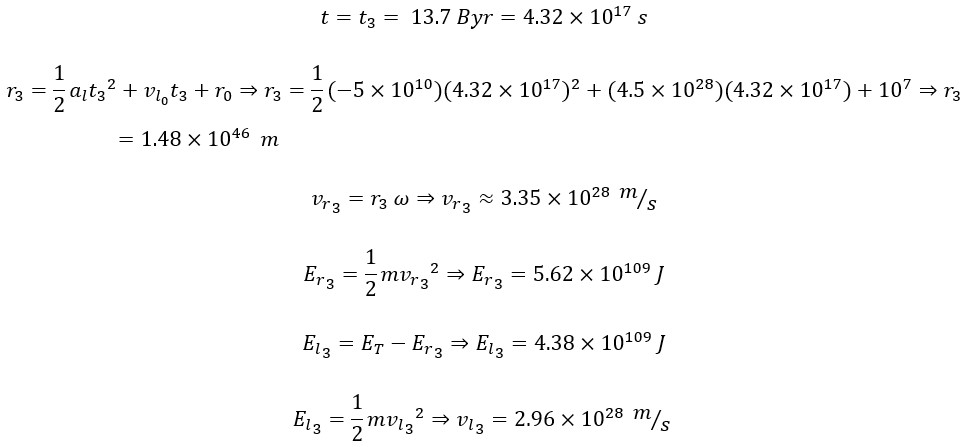
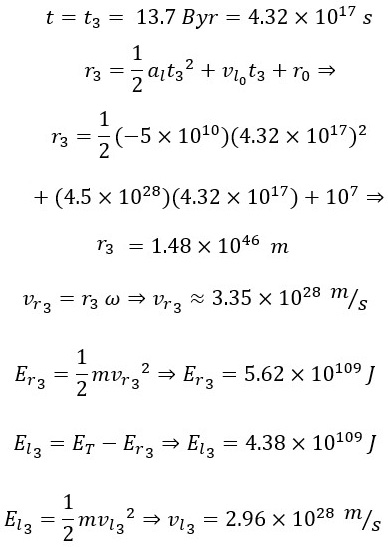
We now proceed to analyze the physical parameters of the universe at present.
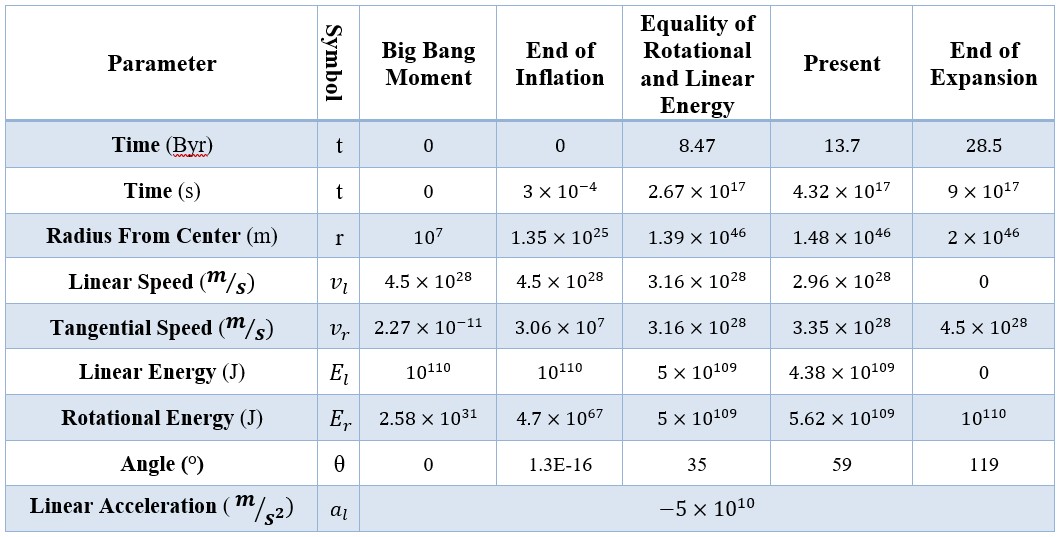
We present a summary of the results in the table below:
Note: Based on the above explanations, every phenomenon is governed by a specific axial and temporal cycle.
Post-Inflation:
The initial explosion imparted both rotational and linear motion to the particles. As the great cloud expanded, it maintained this rotation. Through gravitational attraction, particles unified into primordial stars. Primordial black holes then provided the necessary force to gather these stars into the primordial galaxies.
Note: The effective factor gathering the initial galactic dusts together and the formation of primary stars is the gravitational force of the primary black holes, and then the gravitational force between the atoms, as well as getting cold and other forces. Initial planets are also due to gravitational force between their particles and the presence of gravitational force of primary stars, that gathered particles together, therefore the planets are formed. As particles gathered to form planets, their inherent linear motions beside the rotational motions were conserved. This internal momentum resulted in the planets’ rotation around their own axes and their orbital revolution around stars.
Conclusion: The Nature of Inflation
Inflation is defined as an enormous gaseous expanse in which particles move away from one another (in opposite directions, they don't differ greatly in speed) while simultaneously maintaining rotational motion. While their linear motion is decelerating, their rotational motion is accelerating. This mechanical model ensures that the Universe continuously occupies more space, with its volume increasing over time.
Notice: Just as stars or groups of massive objects die and are reborn, the Universe itself likely has a beginning and an end, eventually returning to its initial state. This suggests that throughout time, there have been multiple inflationary periods and multiple "Universes," each possessing a specific total mass.
References:
[1] Saleh, Gh. "New Computational Table of Physical Parameters for the Moments of Beginning, Inflation, Present, and End of the Universe 2025." Saleh Theory, 29 Jan. 2025, https://www.saleh-theory.com/article/new-computational-table-of-physical-parameters-for-the-moments-of-beginning-inflation-present-and-end-of-the-universe-2025
[2] Saleh, Gh. "A New Perspective on Dark Matter and Cosmic Inflation." APS Meeting Abstracts. 2025.
[3] Saleh, Gh. "A Simple and Fluent Explanation of the Big Bang (Pre-Big Bang, Onset, Mid-Term, and End) in the Universe, Utilising Mathematical and Physical Equations, Logic, and Philosophy." Saleh Theory, 24 Dec. 2025, https://saleh-theory.com/article/a-simple-and-fluent-explanation-of-the-big-bang-pre-big-bang-onset-mid-term-and-end-in-the-universe-utilising-mathematical-and-physical-equations-logic-and-philosophy
[4] Saleh, Gh. " New Discoveries Using the Density of Galaxies in Universe 2025 (Elya Phenomenon)." Saleh Theory, 20 Jan. 2025, https://www.saleh-theory.com/article/new-discoveries-using-the-density-of-galaxies-in-universe-2025-elya-phenomenon
[5] Saleh, Gh. "A New Explanation for Dark Matter Based on the Principle of Inflation 2025." Saleh Theory, 5 Jan. 2025, https://www.saleh-theory.com/article/a-new-explanation-for-dark-matter-based-on-the-principle-of-inflation-2025
 Download PDF