A New Explanation for the Elliptical Nature of Fluxes
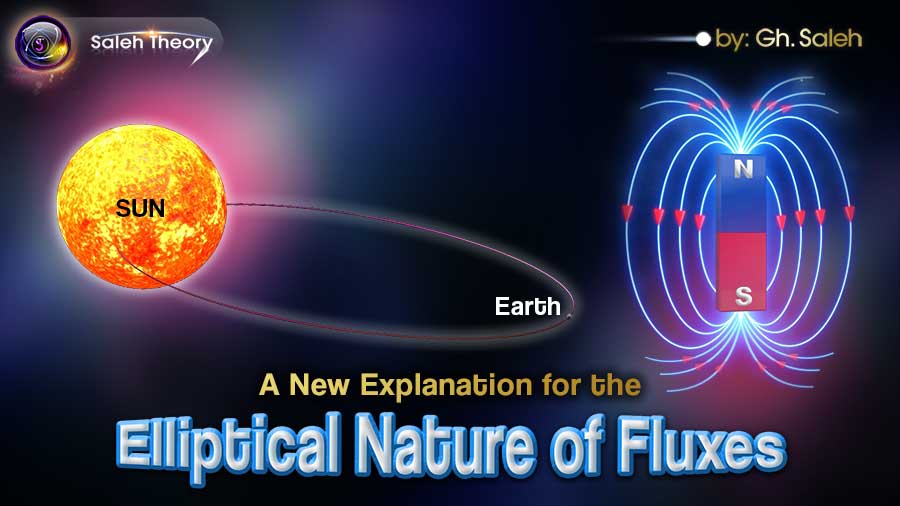
If you have ever observed magnets and iron filings, you have surely noticed the curved lines that emerge from one pole and enter the other. These lines, known as magnetic fluxes, contrary to the common perception that views them as a collection of independent lines, actually possess a singular and continuous structure. Here, we will take a fresh look at the nature of these fluxes and the reason behind their distinct shape.
Magnetic Flux; A Chain of Photons
To properly understand this phenomenon, we must first know what magnetic flux is. Magnetic flux is composed of photons that are linked together in a special way. These photons are not independent or separate from each other; rather, they are intertwined, forming a structure resembling the links of a chain. Each link in this chain is a photon connected to the next, shaping a continuous and unbreakable chain. (This is due to the external motion of photons.)
The important difference in this perspective is that this chain never breaks. The chain always remains continuous and integral, and all photons move together, side by side.
Helical Motion; The Chain-like Dance of Photons
But the more astonishing part is the manner in which this photon chain moves. This intertwined chain, on its path between the two poles of the magnet, exhibits helical motion. This means it neither moves in a straight line nor in a simple circle; instead, like a hypothetical spring stretched in space, it rotates around an invisible axis while simultaneously advancing forward. All the links of this chain execute this helical motion collectively and in harmony.
The Reason for the Elliptical Shape of Flux Lines
Now we arrive at the main question: Why do the flux lines, drawn from the N pole to the S pole, have an elongated, elliptical shape?
The answer lies in the way this photon chain moves between the two poles. The chain exits the N pole and, with its helical motion, heads towards the S pole. However, when it reaches the S pole, the story doesn't end there. The S pole, possessing an attractive property, pulls this chain towards itself, but this attraction does not signify the chain's stop or destruction.
What happens is this: Upon reaching the S pole, the photon chain changes its course and returns towards the N pole. This return, however, occurs at a new angle and via a different path. It's as if the chain is in constant transit between the two poles.
A Continuous Cycle; An Eternal Dance
This back-and-forth motion—from the N pole to the S pole and back again—repeats numerous times. But the crucial point is that this chain never breaks, and all photons participate in this transit uniformly and together. The chain exits the N pole, moves towards the S pole with a helical motion, reaches the S pole, and then, with a delicate turn, returns towards the N pole.
If the chain's motion were only a one-way trip from the N pole to the S pole, perhaps straight lines or simple semicircles would be observed. But what occurs is a perpetual and continuous back-and-forth motion within a helical trajectory. The chain is constantly traveling between the two poles, and this unfailing cycle creates a path that is no longer straight nor entirely circular, but takes on an elongated, elliptical form.
Helical Motion and the Elliptical Shape
What role does the helical motion play in this? The helical motion causes the chain, as it moves from one pole to the other, to cover more space and gives its path a three-dimensional aspect. When this helical motion combines with the continuous back-and-forth motion between the poles, the final result is lines that, while elongated and elliptical, also bear traces of helical twisting.
Therefore, it can be said that the elliptical shape of magnetic flux lines is an image reflecting the interaction of three principal characteristics:
1. The chain-like and intertwined structure of photons, which maintains the continuity of the flux.
2. The helical motion of this chain, which imparts a rotational and three-dimensional quality to the path.
3. The continuous back-and-forth cycle of the chain between the two poles, which causes the elongation of the path.
The elliptical lines of magnetic flux, as depicted by iron filings, are in essence a map of this complex and beautiful dance of the photon chain—a dance where the chain never breaks, all links move together in coordination, and the perpetual transit between the two poles draws an eternal pattern of harmonious ellipses across the expanse of existence.
References:
[1] Vinciarelli, Patrizio. "Collapse of Flux Lines—the Invisible String." Physical Review Letters 38.21 (1977): 1179.
[2] Franklin, Joel, David Griffiths, and Darrell Schroeter. "A taxonomy of magnetostatic field lines." American Journal of Physics 92.8 (2024): 583-592.
[4] Saleh, Gh. "A New and Simple Explanation for the Existence of Invisible Cables in the Universe." Saleh Theory, 28 Sep. 2025, https://www.saleh-theory.com/article/a-new-and-simple-explanation-for-the-existence-of-invisible-cables-in-the-universe
[5] Saleh, Gh. "New Discoveries About Magnetism." Saleh Theory, 08 Jun. 2025, https://saleh-theory.com/article/new-discoveries-about-magnetism
[6] Saleh, Gh. "New Marvelous and Revolutionary Discoveries About Gravity." Saleh Theory, 08 Nov. 2023, https://www.saleh-theory.com/article/new-marvelous-and-revolutionary-discoveries-about-gravity
[7] Saleh, Gh. "New Discoveries About Gravity?!!! 2." Saleh Theory, 12 Dec. 2021, https://www.saleh-theory.com/article/new-discoveries-about-gravity-2
[8] Saleh, Gh. "New Discoveries About Gravity?!!!." Saleh Theory, 07 Nov. 2021, https://www.saleh-theory.com/article/new-discoveries-about-gravity
 Download PDF