Simple Explanation of the Motion of the Universe and the Orbital Motion of Galaxies
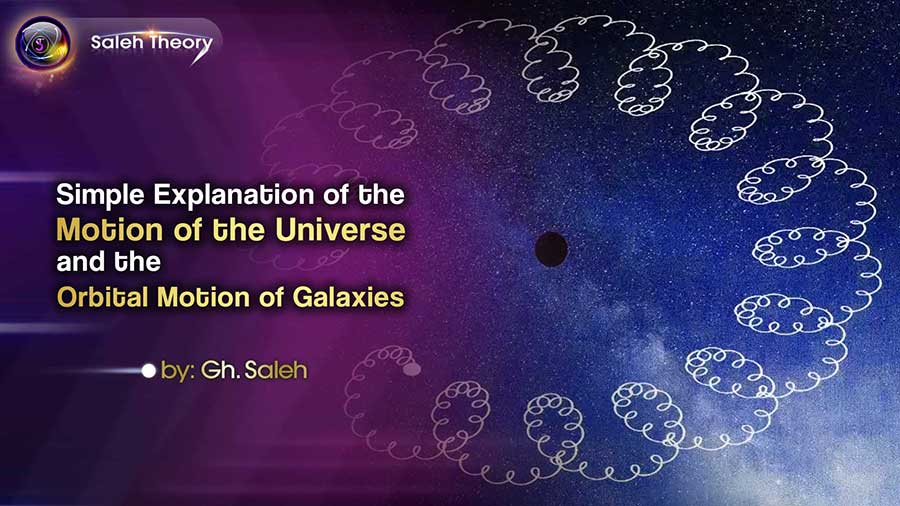
Consider an atom consisting a central nucleus with an electron orbiting it. The electron rotates both about its own axis and in orbit around the central nucleus. Similarly, the Moon rotates around its own axis, orbits the Earth, and orbits its central star, the Sun. The Earth also has such motion, as do the Sun and stars, which rotate around themselves whilst orbiting their central black hole. Extending this principle, each galaxy undoubtedly rotates around its own central axis and simultaneously orbits its rotational centre.
In essence, every celestial object possesses both rotation around its own axis and orbital motion around its primary centre. Like interconnected gears in perpetual rotation, the cosmic wheel of the Universe maintains all objects and particles in rotational motion around their axes. Thus, one may ascribe rotational motion around its own axis and various orbital axes—analogous to the Moon—to every galactic mass, and indeed to the Universe itself, rotating both around its own axis and its rotational centre; all are, and shall remain, in rotation.
Conclusion: Particles from the smallest to the largest all rotate around an axis (either passing through their own centre or orbiting their central nucleus), including the Universe itself and structures beyond the Universe.
References:
[1] Saleh, Gh. " New Explanation for the Types of Real Motion of Galaxies in the Universe." Saleh Theory, 28 Jan 2026, https://saleh-theory.com/article/new-explanation-for-the-types-of-real-motion-of-galaxies-in-the-universe
[2] Saleh, Gh. "A New and Simple Explanation for the Why and How of the Helical Motion of Celestial Objects, from the Smallest (Natural Satellites) to the Largest (Galaxies), in the Universe." Saleh Theory, 25 Oct 2025, https://saleh-theory.com/article/a-new-and-simple-explanation-for-the-why-and-how-of-the-helical-motion-of-celestial-objects-from-the-smallest-natural-satellites-to-the-largest-galaxies-in-the-universe
[3] Saleh, Gh. "10 Identical Characteristics in the Motion of Objects, From the Smallest (Photons) to the Largest (Galaxies)." Saleh Theory, 12 Jul 2025, https://saleh-theory.com/article/10-identical-characteristics-in-the-motion-of-objects-from-the-smallest-photons-to-the-largest-galaxies
[4] Saleh, Gh. "A New Explanation for the Helical Motion of Galaxies Based on a Hubble Telescope Image (Observer's View) in the Universe." Saleh Theory, 1 Sep 2025, https://saleh-theory.com/article/a-new-explanation-for-the-helical-motion-of-galaxies-based-on-a-hubble-telescope-image-observers-view-in-the-universe
[5] Saleh, Gh. "A New Explanation for the Repeating Nested Helical Path of Motion from the Smallest Particles of Existence, Photons, to Moons, Planets, Stars, Galaxies, etc.!." Saleh Theory, 15 Jul. 2023, https://saleh-theory.com/article/a-new-explanation-for-the-repeating-nested-helical-path-of-motion-from-the-smallest-particles-of-existence-photons-to-moons-planets-stars-galaxies-etc
[6] Saleh, Gh. "The Principle of Complex Helical Motion, From Photon to Planets, Stars, Galaxies, … in the Universe." Saleh Theory, 13 May 2023, https://saleh-theory.com/article/the-principle-of-complex-helical-motion-from-photon-to-planets-stars-galaxies-in-the-universe
 Download PDF
Articles