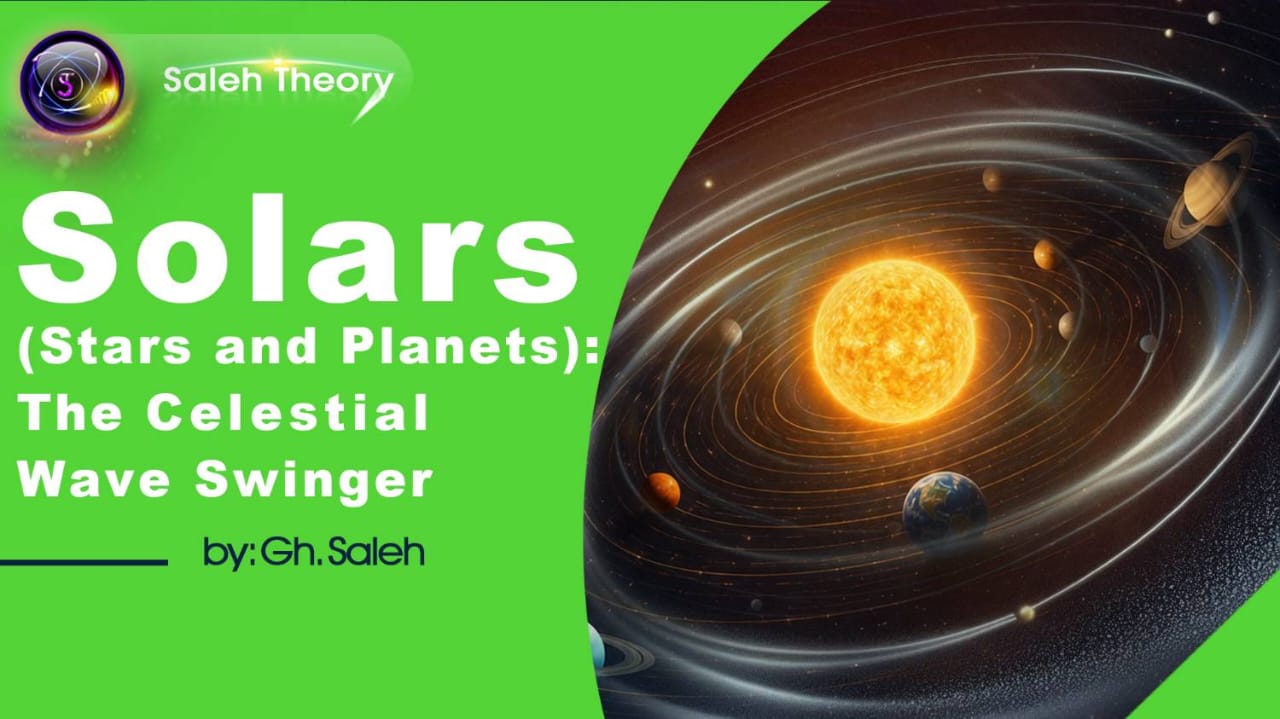
Solars (Stars and Planets): The Celestial Wave Swinger
When a solar system such as our own is considered, it is evident that this system has attained a state of equilibrium, uniformity, coordination, and homogeneity, since the rotational period of a planet about its own axis, or its orbital period about its central star, can be calculated with an accuracy of several seconds or hundredths of a second.
If it is assumed that the central star was, for whatever reason, to disappear, it is evident that the entire planetary structure would disintegrate. If the star were to diminish in mass amount, its gravitational influence would correspondingly decrease, and the planets would gradually recede from the star. Conversely, if the star were to increase, the consequent increase in gravitational influence would cause the planetary orbits to draw closer to the star.
Consider a wave swinger possessing a central axis at which a main hub is located, from which chains are suspended; seats are attached to these chains. As the wave swinger begins to rotate, the seats gradually gain speed, and as the rotational speed increases further, the seats move progressively closer to the horizontal plane. It may indeed be stated that the rotation of the carousel causes the seats to gain speed, thereby generating a centrifugal force; as the seats gain further speed, this centrifugal force increases correspondingly, causing the seats to move away from the ground and approach the horizontal plane, to the extent that they may eventually move within a horizontal plane perpendicular to the carousel's axis.
Similarly, when the rotation of the central star within a solar system decrease, the velocity of the planets orbiting that star decreases correspondingly; conversely, when the rotational speed increases, the velocity of the planets orbiting their star increases. If the rotation of a star were to become very slow, or were to cease entirely, the planets would, owing to gravitational attraction, gradually draw closer to the star and ultimately be drawn into it.
References:
[1] Saleh, Gh. "A Lucid Explanation of the Ordered Pairing of Planets in Our Solar System." Saleh Theory, 24 Jun 2026, https://saleh-theory.com/article/a-lucid-explanation-of-the-ordered-pairing-of-planets-in-our-solar-system
[2] Saleh, Gh. The Reform Book: A Revolution in Modern Physics. Volume Ⅱ, Saleh Research Centre, 2026, https://saleh-theory.com/files/article/pdf/the-reform-book-a-revolution-in-modern-physics-vol2-2026.pdf
[3] Saleh, Gh. "The Principle of Helical Motion from the Smallest Particle (Photon) to the Largest (Galaxies)." Saleh Theory, 14 Sep 2025, https://saleh-theory.com/article/the-principle-of-helical-motion-from-the-smallest-particle-photon-to-the-largest-galaxies
[4] Saleh, Gh. The Reform Book: A Revolution in Modern Physics. Vol. 1, Saleh Research Centre, 2026, https://saleh-theory.com/files/article/pdf/the-reform-book-a-revolution-in-modern-physics-2026.pdf
[5] Saleh, Gh. "The Principle of Complex Helical Motion, From Photon to Planets, Stars, Galaxies, … in the Universe." Saleh Theory, 13 May 2023, https://saleh-theory.com/article/the-principle-of-complex-helical-motion-from-photon-to-planets-stars-galaxies-in-the-universe
 Download PDF
Articles