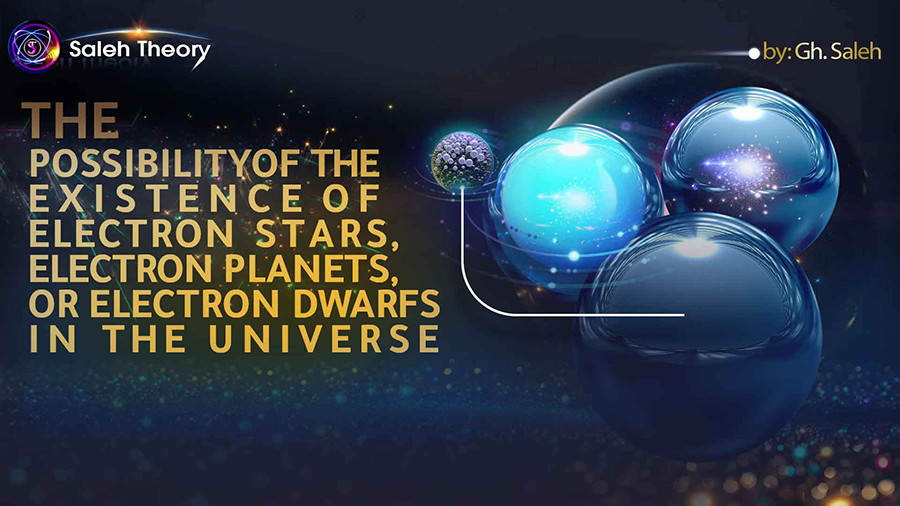
The Possibility of the Existence of Electron Stars, Electron Planets, or Electron Dwarfs in the Universe
Given that the Universe is characterised by diversity, variability, and a wide range of phenomena, and that within it, various types of interactions occur under different physical models, one may argue that any configuration that can be conceived by the human mind may be realised in nature and within the Universe.
As an illustrative example, matter exists in four fundamental states: Gas, Liquid, Solid, and Plasma. With these four states of matter, the formation of all diverse structures observed in nature becomes possible. Accordingly, the existence of any model, any form of matter, or any particular element or atom, in a variety of configurations, may be realised within the Universe.
If purely proton stars (white dwarfs) or purely neutron stars (magnetars) exist in nature, it is then conceivable that, in certain regions of the Universe, electron stars, electron dwarfs, or other special models—predominantly or entirely composed of electrons—may also exist. From this perspective, such models can be defined and considered as candidates for telescopic searches and observational investigations.
References:
[1] Chandrasekhar, Subrahmanyan. "The maximum mass of ideal white dwarfs." Astrophysical Journal, vol. 74, p. 81 74 (1931): 81.
 Download PDF