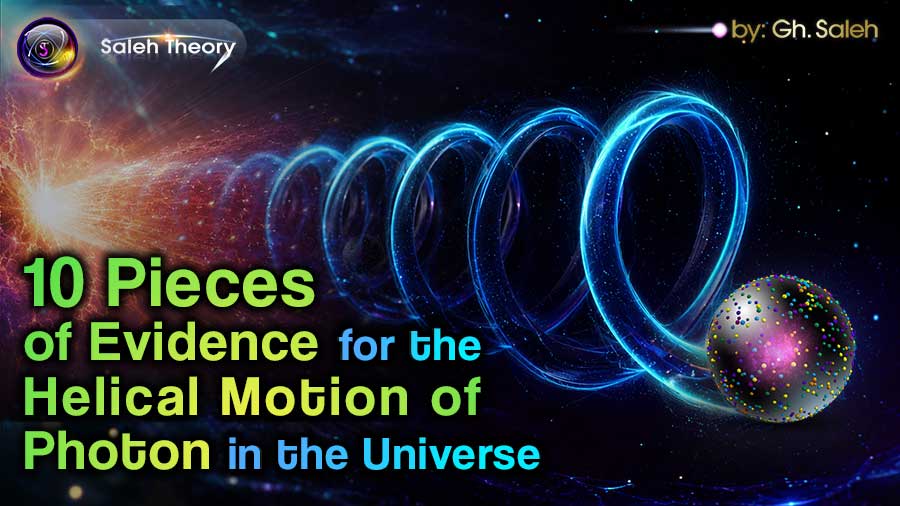
10 Pieces of Evidence for the Helical Motion of Photon in the Universe
Motion and rotation are among the most fundamental features observed throughout the universe. From microscopic particles to large astronomical structures, rotational and orbital motions exist at various scales. Electrons possess angular momentum, planets rotate around their axes and orbit stars, stars move within galaxies, and galaxies themselves participate in larger cosmic structures.
Given the prevalence of these rotational patterns, one may ask whether electromagnetic waves and photons might also follow a more complex trajectory than purely straight-line motion. In the conventional description, a photon propagates through space at the speed of light, (c), and its wave properties are described through the electromagnetic field. The present model proposes a different interpretation: a photon may be regarded as a particle whose overall trajectory contains rotational and linear components together (helical motion).
From this perspective, the wave-like behavior of light does not necessarily mean that the photon changes its physical nature from a “particle” into a “wave.” Rather, wave phenomena may arise from the geometry and dynamics of the photon’s motion.
This article presents 10 arguments in support of the proposed model of the helical motion of photon. These arguments are based on interference and diffraction phenomena, the relationship between photon energy and momentum, wave-particle duality, the description of motion in higher dimensions, the behavior of different wavelengths, the motion of the electron that generates the photon, and the extensive rotational structures observed throughout the universe.
1. Double Slit experiment
The reason for not accepting the constant rest-mass for photons and believing in its wave-like state was the famous experiment of Thomas Young. In this experiment, interference patterns are observed and to justify them, they are considered light as a wave. But the question is, why does an Electron whose rest-mass has been proven to be constant also has an interference pattern in Young’s double-slit experiment? Therefore, it seems that existence of interference patterns is related to the motion of particle not the nature of it.
2. Correspondence Principle
In the wave-particle duality theory, the wave motion pattern considered for the photon's motion is a sine wave. And as you know, a sine wave is equivalent to the shadow of a circular motion (helical motion) on a two-dimensional diagram. Therefore, Saleh theory has the Correspondence principle and in its two-dimensional state, it reaches the wave-particle theory. In other words, wave- particle theory is a special case or an incomplete two-dimensional view of the larger set of Saleh theory.
3. Existence of sinusoidal motion only in material mediums (environments)
In non-material mediums, there is no sinusoidal motion. The rotational motion around the central axis, simultaneously with the linear motion, is common in many phenomena, such as the real motion of the Earth around the Sun in galaxy or a bullet coming out of the barrel of a gun.
4. Red light is the warm light and blue is the cold one
According to the wave-particle duality theory, the mass of a blue photon is assumed to be about twice the mass of a red photon. On the other hand, the energy of blue light is estimated to be higher than the energy of red light due to its higher frequency. Whereas visually and sensually, the red light is heavier, stronger and warmer than the blue light. But in Saleh theory, the red light, due to having a larger gyroradius than blue one, has more rotational energy. Therefore our eyes feel the red light warmer than the blue.
5. Head-on perception of the light
The eyes of human perceive the light only when the ray of light enters the eye head-on. On the other hand, as you know according to the wave-particle duality theory, with changing the frequency the different colors are created. If we look at a light ray head-on, we will see a point in front of us moving up and down, and we will not be able to see any difference between the blue or red light with different wavelengths. But in Saleh Theory, the difference in colors of the light is due to their difference in the gyroradius of their photons. Therefore, the photons of red light and the blue one that come from the front side to our eye have different rotation radiuses, and our eyes perceive this difference in radius and perceive it as two different colors.
6. The amount of electrical energy production in solar cells
Experiments show that amount of electrical energy production in solar cells, have a direct relation to the wavelength of the entered light. Thus, in the visible light spectrum, the red light has a higher output than the blue light. But as mentioned, according to the wave-particle theory, the red light is considered to have lower energy than blue one. However in Saleh theory, the red light photons, due to their larger gyroradius, have more rotational energy than the blue light photons. Therefore, it is natural for the red light photons to show better efficiency in solar cells.
7. Using red light as hazard and warning lights
Visibility of red light in longer distances has become a reason to use as hazard and warning lights in different places. However, in wave-particle theory the energy of the red light photons are considered to be less than that of blue light. But in Saleh theory, the red light photon has larger gyroradius and as a result has more rotational energy than blue light.
8. The evanescent of red light respective to the blue light
The experiments have demonstrated that the evanescent of the red light is more than the blue light. However, according to the wave-particle duality theory, the red light photons with less energy than blue light should have a lower Evanescent. But in Saleh theory, the red light photons have larger radius of rotation than the blue light, and as a result they will have a greater penetrating to the clad of fiber.
9. Collision of two different rays (E.g. red and green)
According to wave-particle theory, it is believed that when two different photons like red and green ones collide with each other, a new photon (yellow) will be created. The mass of which is not the sum of the two original masses but it's their average. And more interestingly, this new photon has average energy and not total energy. Furthermore, without any loss or waste of energy, in less than a thousandth of a second, this newly created mass is converted back into exactly the same two original masses, namely the green and red light photons with their own energy. Aside from violating the conservation law of linear momentum, this event is technically impossible in physics. But in Saleh theory photons of red, green and yellow are all possessing mass and equal total energy, but different radiuses of rotation. Therefore, at the point of intersection, we will have two photons, which the mass of each is equal to the mass of the red and green photons, and there is no change in mass.
10. Possibility of existence of constant mass for photons
According to Louis de Broglie's theory, all matters have dual nature, and this is not merely limited to the light. For example, Electrons that have constant mass have wave-like nature at the same time. Therefore, it is not impossible for a photon to have a fixed mass. And this is the point that is considered in Saleh theory.
Conclusion
This article presented 10 arguments for examining the possibility that photons may follow helical paths through space rather than moving along perfectly straight trajectories. This proposed interpretation examines phenomena such as interference, diffraction, wave-particle duality, photon energy, wavelength-dependent behavior, the motion of the emitting electron, and multidimensional descriptions of motion within a common geometric framework.
According to this model, the photon remains a particle throughout its propagation, but its trajectory may include translational, rotational, vibrational, and even nested helical components. Consequently, the wave-like behavior observed in interference and diffraction experiments can be interpreted as a feature arising from the geometry and dynamics of photon motion, rather than requiring the photon to transform from a particle into a wave.
Within this framework, additional internal or rotational motions may play a role in the overall dynamic structure of the photon.
From this perspective, the proposed helical motion of photon may provide a framework for examining the unity of translational, rotational, and vibrational motion, together with wave-like properties, within a unified description of the photon.
References:
[1] Saleh, Gh. The Reform Book: A Revolution in Modern Physics. Volume Ⅱ, Saleh Research Centre, 2026, https://saleh-theory.com/files/article/pdf/the-reform-book-a-revolution-in-modern-physics-vol2-2026.pdf
[2] Saleh, Gh. The Reform Book: A Revolution in Modern Physics. Vol. 1, Saleh Research Centre, 2026, https://saleh-theory.com/files/article/pdf/the-reform-book-a-revolution-in-modern-physics-2026.pdf
[3] Saleh, Gh. "10 Evidences for the Helical Motion of Electromagnetic Waves in the Universe." Saleh Theory, 25 Jul. 2025, https://saleh-theory.com/article/10-evidences-for-the-helical-motion-of-electromagnetic-waves-in-the-universe
[7] Saleh, Gh. "The Helical Motion of Photons; The Proof of Wave-Particle Duality of Photons." APS Meeting Abstracts. 2023.
[9] Saleh, Gh. "10 Great Reasons for Helical Motion of Photon." APS Meeting Abstracts. 2022.
[11] Saleh, Gh. "10 Great Reasons for Helical Motion of Photon." Saleh Theory, 18 Aug. 2021, https://www.saleh-theory.com/article/10-great-reasons-for-helical-motion-of-photon
[13] Saleh, Gh. "The Discovery of the Nature of Superstring Theory." Saleh Theory, 27 Oct. 2017, https://www.saleh-theory.com/article/the-discovery-of-the-nature-of-superstring-theory
 Download PDF
Articles
B) New Theoretical Derivation of Its Frequency, Mass, Energy, Speed, Constant, etc