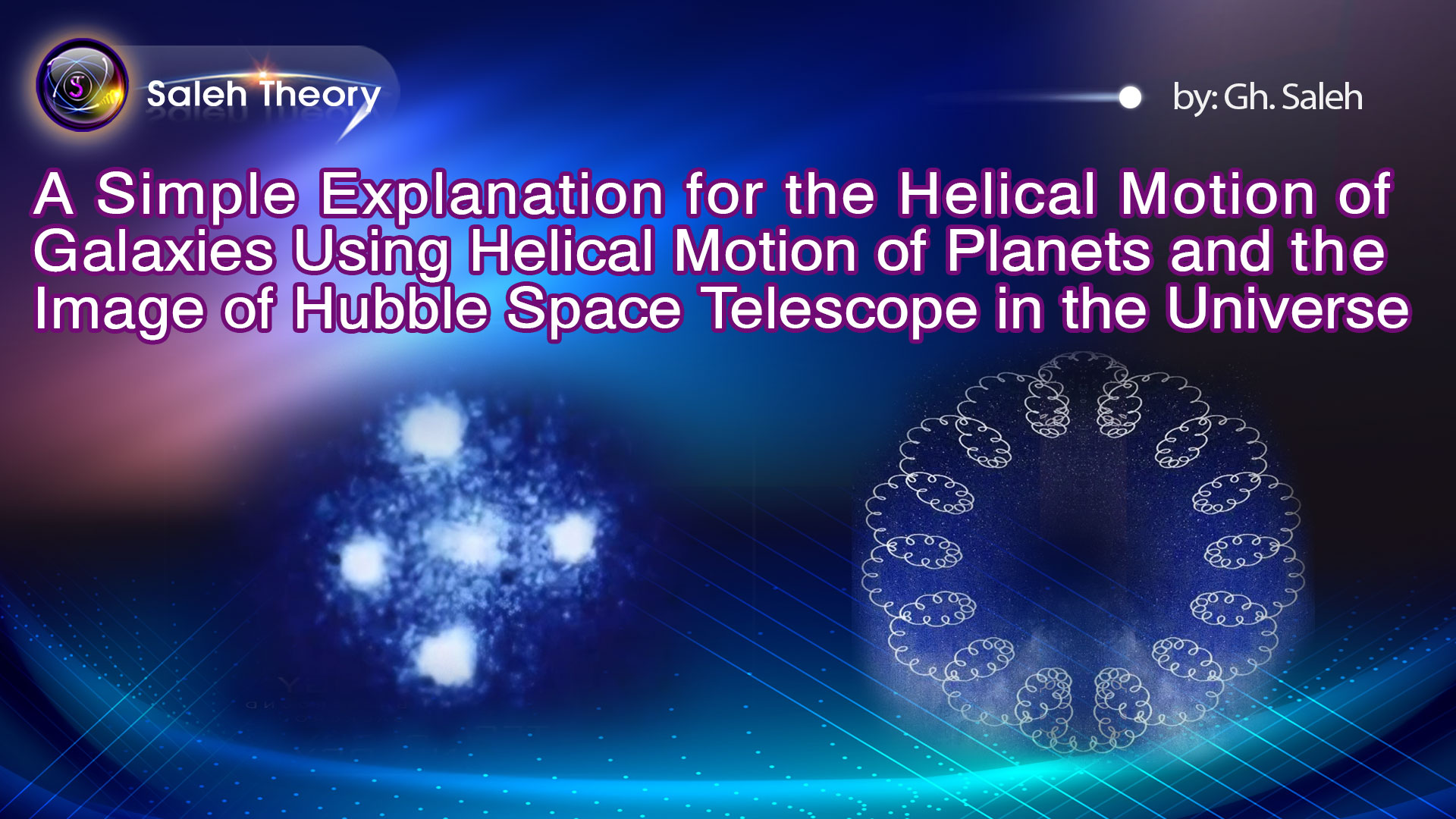
A Simple Explanation for the Helical Motion of Galaxies Using Helical Motion of Planets and the Image of Hubble Space Telescope in the Universe
When considering the Lunar system, the Moon rotates on its axis while orbiting the Earth; concurrently, as the Earth orbits the Sun, the Moon is forced to follow this primary orbital path. Consequently, the Moon maintains a dual orbital trajectory: one relative to the Earth and another relative to the Sun.
To accurately represent the Moon's total displacement through space, one must characterise it as helical motion. This arises because the Moon’s rotation around the Earth occurs while the Earth itself is in rotation around the Sun. The vector summation of these two rotational motions results in a helical path, analogous to the structure of an elongated mechanical spring.
In fact, the Moon’s motion is such that it should rotate around the Earth and consequently rotate around the Sun; so, its motion would be helical. Like a galaxy is a constituent of a cluster, which in turn resides within a supercluster, it undergoes multiple rotations: around its own galactic centre, around the barycentre of its local cluster, and in relation to its respective supercluster.
Given that a galaxy is engaged in rotational motion across at least two distinct axes simultaneously, it follows that every galaxy must exhibit at least one form of helical progression.
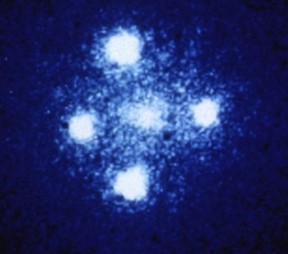
Fig 1: Captured by Hubble Telescope
The accompanying image captured by the Hubble Space Telescope illustrates this phenomenon: Frontal Perspective: When viewed from a direct or "face-on" orientation, the galaxy exhibits its primary helical trajectory.
Lateral Perspective: Conversely, when observed from a lateral or "edge-on" orientation, this helical motion manifests as an oscillatory or wave-like pattern. From this vantage point, the galaxy appears to undergo a periodic vertical displacement, moving "up and down" relative to the observer's line of sight.
References:
[1] Saleh, Gh. "10 Identical Characteristics in the Motion of Objects, From the Smallest (Photons) to the Largest (Galaxies)." Saleh Theory, 12 Jul 2025, https://saleh-theory.com/article/10-identical-characteristics-in-the-motion-of-objects-from-the-smallest-photons-to-the-largest-galaxies
[2] Saleh, Gh. "A New Explanation for the Helical Motion of Galaxies Based on a Hubble Telescope Image (Observer's View) in the Universe." Saleh Theory, 1 Sep 2025, https://saleh-theory.com/article/a-new-explanation-for-the-helical-motion-of-galaxies-based-on-a-hubble-telescope-image-observers-view-in-the-universe
[3] Saleh, Gh. "A New and Simple Explanation for the Why and How of the Helical Motion of Celestial Objects, from the Smallest (Natural Satellites) to the Largest (Galaxies), in the Universe." Saleh Theory, 25 Oct 2025, https://saleh-theory.com/article/a-new-and-simple-explanation-for-the-why-and-how-of-the-helical-motion-of-celestial-objects-from-the-smallest-natural-satellites-to-the-largest-galaxies-in-the-universe
[4] Saleh, Gh. "A New Explanation for the Repeating Nested Helical Path of Motion from the Smallest Particles of Existence, Photons, to Moons, Planets, Stars, Galaxies, etc.!." Saleh Theory, 15 Jul. 2023, https://saleh-theory.com/article/a-new-explanation-for-the-repeating-nested-helical-path-of-motion-from-the-smallest-particles-of-existence-photons-to-moons-planets-stars-galaxies-etc
[5] Saleh, Gh. "The Principle of Complex Helical Motion, From Photon to Planets, Stars, Galaxies, … in the Universe." Saleh Theory, 13 May 2023, https://saleh-theory.com/article/the-principle-of-complex-helical-motion-from-photon-to-planets-stars-galaxies-in-the-universe
 Download PDF
Articles