New Discoveries on Photon Energy Discrepancies, Their Physical Interpretation, and the Construction of Thermal Telescopes Based on the Universally Valid Planck Equation and the Saleh Simple Experiment
It can be readily argued and demonstrated that the higher the frequency of an electromagnetic wave, the greater the amount of energy its photons can transfer. But what is the physical explanation for this behaviour?
In previous articles, we explained that the mass of photons is constant and that their speed is necessarily constant in linear, wave-like, and rotational modes.
To address the question raised above, we now present an example. The following figures show three moving objects that start from the same initial point O with the same constant speed and reach the final points, A, B, and C, respectively.
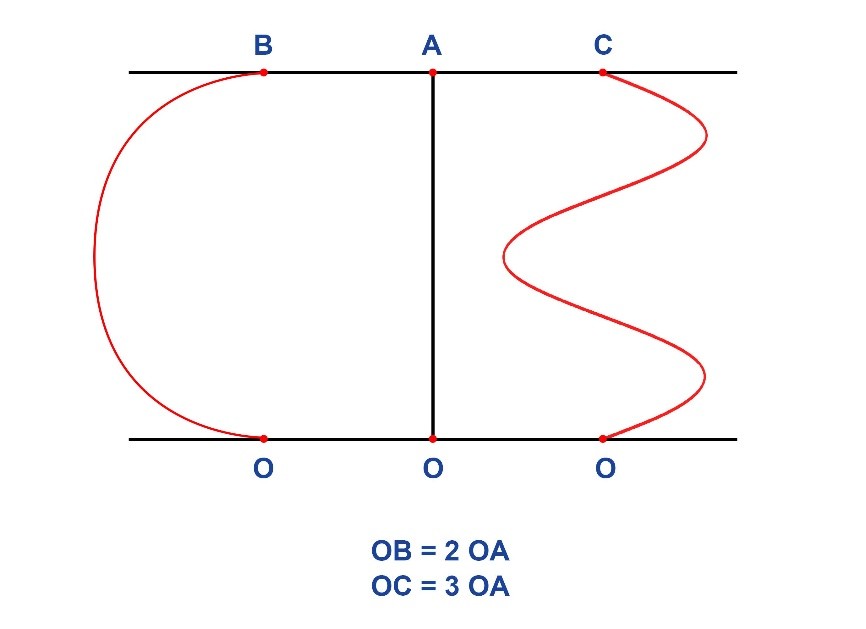
Given that their speeds are identical, the only varying parameter is the distance from the origin to the destination, and one may write:

Therefore, if three objects move at the same constant speed but along paths of different lengths, their arrival times at the destination will differ.
In other words, within equal time intervals, when the first moving object reaches its destination, the second has reached only halfway, and the third has traversed one-third of its path. Now, suppose we have a set of objects that start moving at identical speeds in a regular, periodic manner, such that at fixed time intervals, whenever one object reaches the end of its path, the next object on the same path begins its motion.
In this case, if within a fixed time interval (for instance, six hours), six moving objects reach the destination along the OA path, only three along the OB path, and only two along the OC path. In practice, the number of objects reaching the destination depends on the length of the path: the longer the path, the fewer objects reach the destination; the shorter the path, the more objects which arrive.
Now we notice the figures for electromagnetic waves. Considering the differences in the wave-like trajectories of photons with different frequencies (such as red, green, and blue spectra), we analyse the number of photons that reach the destination for each frequency. The wave-like path of the red spectrum is longer than that of the green and blue spectra. Consequently, fewer red-light photons reach the destination, and it is evident that the amount of energy transferred by the red spectrum is less.
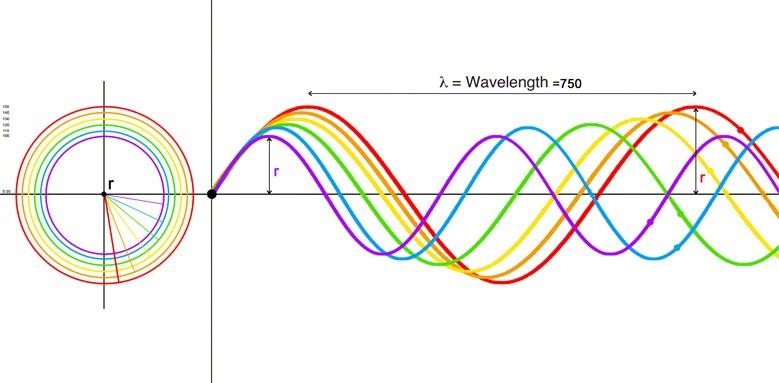
The same reasons are achieved when comparing green and blue spectra. Since the motion path length of green spectrum is longer than that of blue spectrum, fewer green photons reach the destination, and therefore, the energy transferred by green spectrum is less than that transferred by the blue one. Accordingly, one may always consider a proportionality, which is defined as the ratio of the frequency (or energy) of the given spectrum to the frequency (or energy) of a reference spectrum. In this work, green spectrum with a frequency of 600 THz is chosen as the reference.
Thus, for the green spectrum is n=1. Conversely, if a measured value of n=1 is obtained, the photon corresponds to the green spectrum. In the same way, if n>1, the spectrum under consideration lies toward blue and violet region of the electromagnetic spectrum diagram, whereas if n<1, it lies toward yellow and red region.
In other words, if we close our eyes and expose the palms of our hands to several light beams, we can distinguish different types of light based on the differences in perceived energy. Now, if a detector is configured to be sensitive to temperature, it becomes possible to identify the colors of different light sources based on their thermal response.
References:
[1] Saleh, Gh. "New Explanation Concerning Photon Constants Part B The different types of constant speeds value of photon, the constant energy value of photon and the constant density value of photon, could all be true." Saleh Theory, 28 Jun. 2025, https://saleh-theory.com/article/new-explanation-concerning-photon-constants-part-b-br-the-different-types-of-constant-speeds-value-of-photon-the-constant-energy-value-of-photon-and-the-constant-density-value-of-photon-could-all-be-true
[2] Saleh, Gh. "New Explanation Concerning Photon Constants Part A 7 strong reasons that demonstrate the mass of photon is constant." Saleh Theory, 28 Jun. 2025, https://saleh-theory.com/article/new-explanation-concerning-photon-constants-part-a-br-7-strong-reasons-that-demonstrate-the-mass-of-photon-is-constant
[4] Saleh, Gh. " New Uncomplicated Experiment Under Ordinary Conditions (Time, Place, Sunlight, etc.) With Common Tools (Ordinary Lenses and Thermometers) to Demonstrate and Verify the Planck's Experimental Equation." Saleh Theory, 10 Jul. 2024, https://saleh-theory.com/article/new-uncomplicated-experiment-under-ordinary-conditions-time-place-sunlight-etc-with-common-tools-ordinary-lenses-and-thermometers-to-demonstrate-and-verify-the-plancks-experimental-equation
[5] Saleh, Gh. " Discovery of the Hundred-Year-Old Lost Mathematical and Physical Relationship Between the Classical Kinetic Energy of Photons and Planck's Everlasting Experimental Equation in the Universe (Planck-Saleh Energy Equation)." Saleh Theory, 28 Jun. 2024, https://saleh-theory.com/article/discovery-of-the-hundred-year-old-lost-mathematical-and-physical-relationship-between-the-classical-kinetic-energy-of-photons-and-plancks-everlasting-experimental-equation-in-the-universe-planck-saleh-energy-equation
[6] Saleh, Gh. "Virtual Waves Creation, Its Negative Effects and Telescopes Design with Low-Defect." Saleh Theory, 22 Aug. 2023, https://saleh-theory.com/article/virtual-waves-creation-its-negative-effects-and-telescopes-design-with-lowdefect
 Download PDF