Eight Conclusive Proofs of the True Velocity of Light: Experimental, Mathematical, and Physical Evidence from Universal Observations (Vphoton =3.3 C)
The principle of the constancy of the speed of light in vacuum is one of the foundations of Einstein's Special Relativity theory. However, certain experimental observations and theoretical arguments raise the question of whether the intrinsic speed of the photon could exceed the measured value C, with the speed conventionally known as the speed of light representing only its observable component. This paper presents a model in which the true speed of the photon is taken to be approximately 3.3 times the speed of light 3.3 C. The calculation of this speed 3.3 C, based on the helical motion of the photon, was addressed in previous Saleh Theory papers. The relevant calculations are presented below:
When a photon emits from an electron, it will have two small and large helical motions with a constant linear speed of C, and the following equations can be considered:
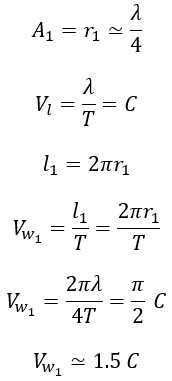
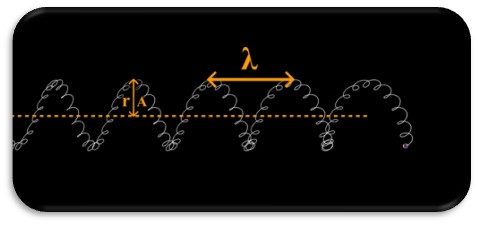
where A1 is the wave's amplitude which is equal to the radius of the photon's helical motion r1, λ represents wavelength, Vl is the linear speed, T is period, C is the speed of light, l1 is the path length of a photon in one complete period and Vw1 is the wave or rotational speed of a photon in large helical motion.
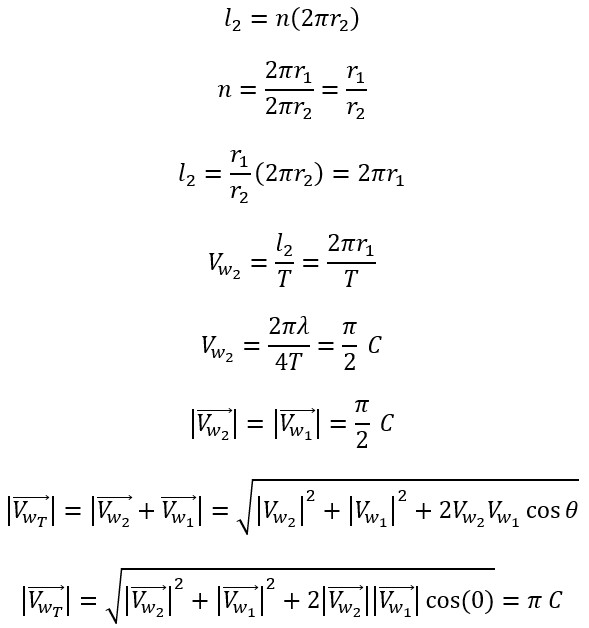
Where l2 is the path length of a photon in small helix in one complete period of big helical motion, n is the number of circles of small helix during on complete circle of big one, r1 is the radius of small helix, Vw2 is the wave or rotational speed of a photon in small helical motion and VwT is the total rotational speed.
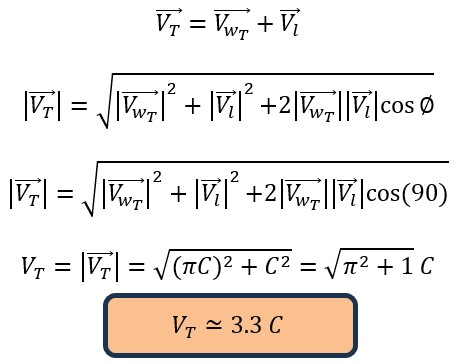
According to the figure, the total speed of a photon can be obtained from the following equations:
The total speed is equal to the sum of the speeds of a photon in two helical paths plus the linear speed
In support of this hypothesis, eight independent arguments are examined, comprising the results of certain university experiments, the behaviour of the electron within the atom, an examination of the Planck relation, the characteristics of light propagation, the phenomenon of colour perception, the performance of solar cells, and the correspondence principle. The aim of the paper is to present a theoretical framework for future research into the possible existence of phenomena exceeding the speed of light.
Since the presentation of the Special Theory of Relativity in 1905, the speed of light in vacuum has been recognised as the maximum speed at which information and matter can be transmitted. Despite the successes of this theory, certain experimental results and theoretical considerations continue to raise questions regarding the true nature of the photon and the manner of its propagation.
This paper assumes that the measured speed of light C is only the observable component of the photon's complex motion, whereas its true speed is approximately 3.3 C. To examine this hypothesis, eight independent arguments are considered:
1. Results of Experiments Conducted by the University of Michigan and MIT
In two independent experiments conducted by MIT and the University of Michigan, it was observed that, at very short distances, the experimentally measured value of electromagnetic wave energy does not conform to Planck's law. According to the papers of the Saleh Research Group, this discrepancy arises from the photon's helical velocity being greater than C. That is explained in detail in the paper “ New Discoveries About the Speed of Electromagnetic Waves 2024 Part C ” of the Saleh Theory.
2. The Resultant of Electron Motions within the Atom
When emitting a photon, the electron is moving at speed C around the nucleus while simultaneously rotating around its own axis at a very high speed. The photon emitted from this electron carries the resultant of these velocities and therefore travels at a speed higher than C.
3. Inconsistency between the Planck Relation and the Kinetic Energy of the Photon
Given that the photon possesses mass, a comparison between the Planck energy and the kinetic energy shows that its speed must exceed C for equilibrium to be established. On this basis, if the final speed of the photon is taken as

regarded as the resultant of the linear motion and the three nested helices of the photon, the following equation
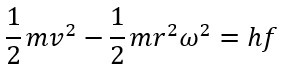
holds for every frequency in the electromagnetic spectrum, and the relationship between the kinetic energy of the photon and the Planck formula is correctly established once the rotational kinetic energy is taken into account.
4. Existence of Sinusoidal Motion Only in Material Mediums (Environments)
In non-material mediums, there is no sinusoidal motion. The rotational motion around the central is, simultaneously with the linear motion, is common in many phenomena, such as the real motion of the Earth around the Sun in galaxy or a bullet coming out of the barrel of a gun. And since the linear velocity of light is equal to C, the resultant helical velocity is greater than C.
5. Red Light is Warm Light or Blue One
According to the wave-particle duality theory, the mass of a blue photon is assumed to be about twice the mass of a red photon. On the other hand, the energy of blue light is estimated to be higher than the energy of red light due to its higher frequency. Whereas visually and sensually, the red light is heavier, stronger and warmer than the blue light. But in Saleh Theory, the red light, due to having a larger gyroradius than blue one, has more rotational energy. Therefore, our eyes feel the red light warmer than the blue one. And this demonstrates that the motion of light is helical, and the helical speed is greater than C.
6. Observing Light Head-On
The eyes of human perceive the light only when the ray of light enters the eye head-on. On the other hand, as you know according to the wave-particle duality theory, with changing the frequency the different colors are created. If we look at a light ray head-on, we will see a point in front of us moving up and down, and we will not be able to see any difference between the blue or red light with different wavelengths. But in Saleh Theory, the difference in colors of the light is due to their difference in the gyroradius of their photons. Therefore, the photons of red light and the blue one that come from the front side to our eye have different rotation radiuses, and our eyes perceive this difference in radius and perceive it as two different colors. And this, too, demonstrates that the motion of light is helical, and consequently the helical speed is greater than the linear speed of light.
7. The Amount of Electrical Energy Production in Solar Cells
Experiments show that amount of electrical energy production in solar cells, have a direct relation to the wavelength of the entered light. Thus, in the visible light spectrum, the red light has a higher output than the blue light. But as mentioned, according to the wave-particle theory, the red light is considered to have lower energy than blue one. However, in Saleh Theory, the red-light photons, due to their larger gyroradius, have more rotational energy than the blue light photons. Therefore, it is natural for the red-light photons to show better efficiency in solar cells. This matter demonstrates that the motion of light is helical.
8. Correspondence Principle
In the wave-particle duality theory, the wave motion pattern considered for the photon's motion is a sine wave. And as you know, a sine wave is equivalent to the shadow of a circular motion (helical motion) on a two-dimensional diagram. Therefore, Saleh Theory has the Correspondence principle and in its two-dimensional state, it reaches the wave-particle theory. In other words, wave- particle theory is a special case or an incomplete two- dimensional view of the larger set of Saleh Theory, and this reason, like the preceding reasons, likewise demonstrates that the motion of light is helical.
This research seeks to demonstrate that, if this evidence is interpreted within a single unified model, the existence of a speed exceeding C for the photon could be proposed and examined as an important principle — and could bring about a fundamental revolution in the field of electronic component manufacturing and in sciences such as astrophysics and physics, among others.
References:
[1] Chandler, David L. “Breaking the Law, at the Nanoscale.” MIT News | Massachusetts Institute of Technology, news.mit.edu/2009/heat-0729 . Accessed 29 July 2009.
[2] Thompson, Dakotah, et al. " Hundred-fold enhancement in far-field radiative heat transfer over the blackbody limit. " Nature 561.7722 (2018): 216-221.
[4] Saleh, Gh. "5 Evidences that Shows the Speed of Photon Is 3.3 C." Saleh Theory, 19 Jul 2025, https://saleh-theory.com/article/5-evidences-that-shows-the-speed-of-photon-is-33-c
[5] Saleh, Gh. "New Proof of Photon Velocity (VT = 3.3 C) Utilising Mathematical Equations, Physical Laws and the Experiments of MIT and Michigan University in the Universe 2025 Part A." Saleh Theory, 26 Apr. 2025, https://www.saleh-theory.com/article/a-new-proof-of-photon-velocity-vsubtsub-33-c-utilising-mathematical-equations-physical-laws-and-the-experiments-of-mit-and-michigan-university-in-the-universe-2025-part-a
[6] Saleh, Gh. "New Proof of Photon Velocity (V_T= 3.3 C) Utilising Ever-True Planck Energy Equation and Kinetic Energy Equation in the Universe 2025 Part B." Saleh Theory, 03 May 2025, https://www.saleh-theory.com/article/a-new-proof-of-photon-velocity-vsubtsub-33-c-utilising-ever-true-planck-energy-equation-and-kinetic-energy-equation-in-the-universe-2025-part-b
[7] Saleh, Gh. "New Proof of Photon Velocity (V_T= 3.3 C) Utilising the Young's Double-Slit Experiment and the Motional Model of Emitted Photons from Electrons in the Universe 2025 Part C." Saleh Theory, 03 May 2025, https://www.saleh-theory.com/article/a-new-proof-of-photon-velocity-vsubtsub-33-c-utilising-the-youngs-double-slit-experiment-and-the-motional-model-of-emitted-photons-from-electrons-in-the-universe-2025-part-c
[8] Saleh, Gh. "New Discoveries About the Speed of Electromagnetic Waves 2024 Part C." Saleh Theory, 06 Nov 2023, https://saleh-theory.com/article/new-discoveries-about-the-speed-of-electromagnetic-waves-2024-part-c
 Download PDF