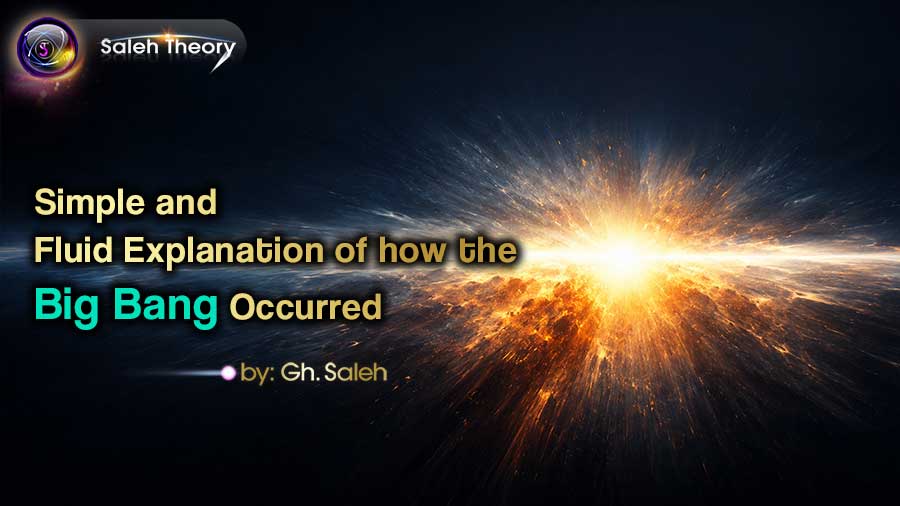
Simple and Fluid Explanation of How the Big Bang Occurred
When observing the surrounding universe and the Earth that we live in, it is evident that various cycles exist, such as daily and yearly cycles. For instance, within a 24-hour period, a complete cycle of day, night, midnight, and midday occurs. During each 365-day period, known as a solar year, the Earth completes a full orbit around the Sun, resulting in the progression of the seasons. It can be asserted that such cycles are established and stable across all planets, stars, and galaxies; indeed, the Earth's annual cycle has been repeated billions of times to date.
Regarding the Big Bang explosion, it is possible to conceptualise a beginning and an end (a return), such that a cycle of beginning and return may be imagined every several tens of billions of years. If multiple cycles are considered, a beginning can be defined for the process, much like the Milky Way galaxy. For example, if the lifespan of the Milky Way is 6 billion years, it follows that 7 billion years ago, the Milky Way did not exist; it was instead formed through the accumulation of celestial dust and intergalactic particles, the enormous explosions and subsequent destruction of primordial galaxies, or other mechanisms.
In any case, every ensemble of galactic systems, clusters, and higher-order structures have motion cycles (of progression and return). Simultaneously, a beginning can be defined for these structures. To define a realistic beginning for the Big Bang—given that it involved an extraordinarily powerful explosion within a minute volume and at extreme density—it must be assumed, based on relevant calculations, that primordial particles such as photons, sub-photons, or up-photons collided at the initial point of the Big Bang.
These particles aggregated to form a mass, generating a strong initial gravitational attraction. Consequently, all matter and particles gathered within this mass, creating an extreme density, which ultimately caused the particles and matter to be ejected from the point zero of the explosion.
In effect, the Big Bang was triggered by the velocity of primordial particles at the initial location. This occurred due to the lack of necessary stability at that site, despite the immense gravity present, resulting in the release of energy in the form of the Big Bang.
References:
[1] Gandolfi, Stefano, J. Carlson, and S. Reddy. “Maximum Mass and Radius of Neutron Stars, and the Nuclear Symmetry Energy.” Physical Review C, vol. 85, no. 3, 2012, p. 032801.
[2] Saleh, Gh. The Reform Book: A Revolution in Modern Physics. Vol. 1, Saleh Research Centre, 2026, saleh-theory.com/files/article/pdf/the-reform-book-a-revolution-in-modern-physics-2026.pdf . PDF download.
[3] Saleh, Gh. "Everything About the Big Bang, From its Beginning to its End." Saleh Theory, 10 Aug. 2025, https://saleh-theory.com/article/everything-about-the-big-bang-from-its-beginning-to-its-end
[4] Saleh, Gh. "New Computational Table of Physical Parameters for the Moments of Beginning, Inflation, Present, and End of the Universe 2025." Saleh Theory, 29 Jan. 2025, https://saleh-theory.com/article/new-computational-table-of-physical-parameters-for-the-moments-of-beginning-inflation-present-and-end-of-the-universe-2025
[5] Saleh, Gh. "Discovery of the Smallest Particle in the Universe, Cidtonium, Using the Big Bang Phenomenon." Saleh Theory, 04 Feb 2023, https://saleh-theory.com/article/discovery-of-the-smallest-particle-in-the-universe-cidtonium-using-the-big-bang-phenomenon
 Download PDF