New Discoveries and Reasons for the Existence of a Speed Faster than Light, whereby Vphoton =3.3 C, in the Universe 2026
A) Fourteen reasons why a speed faster than light exists?
B) Twelve reasons why VPhoton = 3.3 C?
Since Albert Einstein first proposed the Special Theory of Relativity, the speed of light in vacuum has been regarded as one of the most fundamental constants of nature. Despite the considerable successes of this theory, recent advances in cosmology, particle physics and astrophysics have led certain researchers to examine the possibility of revisiting this hypothesis.
The purpose of this text is to present a set of arguments and evidence that render the existence of speeds faster than light. In addition, the proposed 3.3 C model is introduced, according to which the true speed of the photon is taken to be faster than the conventionally accepted value, and many physical phenomena can be interpreted on this basis.
A) Fourteen Reasons Why a Speed Faster Than Light Exists?
1. Proof of a Speed Faster Than Light Using Hubble's Law
If the observed boundary of the universe, namely 1024 km, is substituted into the Hubble formula, it becomes apparent that galaxies situated at this distance are, at the present time, moving at a speed faster than that of light.

2. Proof of a Speed Faster Than Light in the Initial Moments after the Big Bang
Following the great explosion, once a small quantity of energy had been expended in creating matter, the remaining energy manifested itself as kinetic energy imparted to this matter, resulting in the generation of a speed faster than light. This subject has been addressed in detail in the paper “ New Computational Table of Physical Parameters for the Moments of Beginning, Inflation, Present, and End of the Universe 2025 ”, using the energy released at the moment of the Big Bang, wherein the numerical value of the speed obtained at the instant of the Big Bang explosion was found to be of the order of 1028 m/s — far exceeding the speed of light.
3. Examination of the High-Energy Amaterasu Particle and Its Implications
Given the extremely high energy of this particle — of the order of 1020 eV — its speed, and likewise its density, must be so high, exceeding that of light.
4. Proof of a Speed Faster Than Light Using Redshift (Blueshift)
According to calculations performed in respect of the redshift (blueshift) phenomenon, blueshift can occur only when light from galaxies reaches the observer at a speed faster than the speed of light. For example, if a star emits green light and is moving towards the observer, the speed of the waves received at the observer's location is obtained from the following formula:
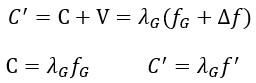
It should be noted that this matter is explained in detail in the paper “ New Discovery of Virtual Waves in the World Or A Revolution in the Manufacturing of Space Telescopes ”, and in respect of virtual waves, in Chapter Eight of “ The Reform Book, A Revolution in Modern Physics 2026; Volume II ”.
5. Proof of a Speed Faster Than Light Using Hubble Space Telescope Data
In 2016, the Hubble Space Telescope succeeded in discovering a galaxy situated at a distance of 32 billion light-years from Earth. Given that the universe is 14 billion years old, the existence of this galaxy at such a distance indicates that it is moving at an average speed of approximately twice the speed of light.

6. The Absence of Any Definitive Proof that a Speed Faster Than Light Does Not Exist
The non-existence of a speed faster than light is a hypothesis put forward approximately 100 years ago, and is not the result of any definitive physical observation or experiment. In other words, no conclusive phenomenon has yet been presented that proves the non-existence of a speed faster than light.
7. Proof of a Speed Faster Than Light Using an Optical Spatial Modulator Device
Researchers at the University of Central Florida (UCF) have introduced a method for controlling the speed of light. They have succeeded in increasing the speed of a light pulse to thirty times the speed of light, thereby exceeding the speed of light, or in reducing it to half the speed of light.
8. Proof of a Speed Faster Than Light Using the Gravity of Black Holes
Since the gravity of black holes is so great that it can bend the path of a photon, and since no light can escape its gravitational pull, it follows that it is capable of affecting the speed of light. Now consider light travelling towards a black hole: the gravity of the black hole will certainly act upon this photon and will inevitably increase its speed, bringing it to a speed faster than the speed of light.
9. Proof of a Speed Faster Than Light by Means of Quantum Equations
The Schrödinger quantum equation does not hold in the relativistic regime (in which the speed of light represents the maximum attainable speed), and in the relativistic case is transformed into the Klein–Gordon and Dirac equations. As a result of this transformation, the equations encounter difficulties, including negative probability density and negative energy for the wave functions. Although the negative energy has been attributed to antiparticles in order to alleviate this problem somewhat, negative probability is, naturally, not physically acceptable; and since this defect does not arise in the non-relativistic equation — that is, the Schrödinger equation — the resulting flaw must be attributed to the assumption of relativity itself, namely the non-existence of a speed faster than light.
10. Results from the MIT and University of Michigan's Laboratories
In two independent experiments conducted by MIT and the University of Michigan, it was observed that, at very short distances, the experimentally measured energy of electromagnetic waves does not accord with Planck's law. According to the papers of the Saleh Research Group, this discrepancy arises from the helical speed of the photon exceeding C — a matter that is explained in full in Chapter One of “ The Reform Book, A Revolution in Modern Physics 2026; vol: 01 ”, in respect of the helical speed of the photon.
11. The Helical Motion of the Photon
According to the model put forward by the Saleh Group, presented in Chapter One of “ The Reform Book, A Revolution in Modern Physics 2026; vol: 01 ”, the photon possesses a helical motion along its direction of propagation, causing its effective speed to reach approximately 3.3 times C.

12. Equations of the Motion of the Cosmos
In the equations put forward by Saleh Research Group for cosmic cycles, during certain phases of the outward and return path of celestial objects between successive Big Bangs, the calculated speeds exceed C — a result that follows directly from the structure of the equations of motion. These speeds have been calculated in the paper “ New Computational Table of Physical Parameters for the Moments of Beginning, Inflation, Present, and End of the Universe 2025 ”.
13. The Discrepancy Between Planck Energy and the Kinetic Energy of the Photon
Given that the photon possesses mass, a comparison of Planck energy with kinetic energy shows that its speed must exceed C in order for equilibrium to be established. On this basis, if the final speed of the photon is taken as:

— being the resultant of the linear motion and the two nested helical motions of the photon — the following equation:
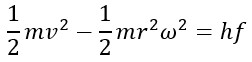
holds true for every frequency within the electromagnetic spectrum, and the relationship between the kinetic energy of the photon and Planck's formula is correctly established when rotational kinetic energy is taken into account.
14. The Resultant of the Electron's Motions during Photon Emission
When emitting a photon, the electron is moving at speed C around the nucleus, and is also spinning about its own axis at a very high speed. The photon emitted by this electron carries the resultant of these speeds, and consequently travels at a speed faster than C.
B) Twelve Reasons Why VPhoton = 3.3 C?
In this section, using the earlier papers of Saleh Research Group demonstrating that the motion of the photon within the universe is helical, the speed of the photon within the nested helix is calculated:
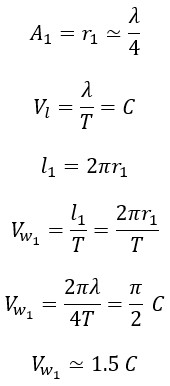
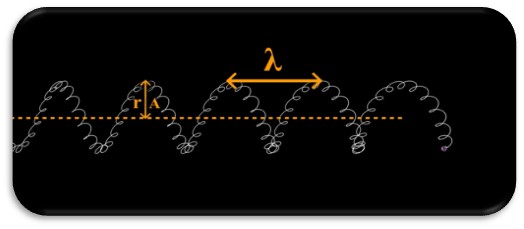
where "A1" is the wave's amplitude which is equal to the radius of the photon's helical motion "r1", “λ” represents wavelength, "Vl" is the linear speed, "T" is period, C is the speed of light, "l1" is the path length of a photon in one complete period and "Vw1" is the wave or rotational speed of a photon in large helical motion.
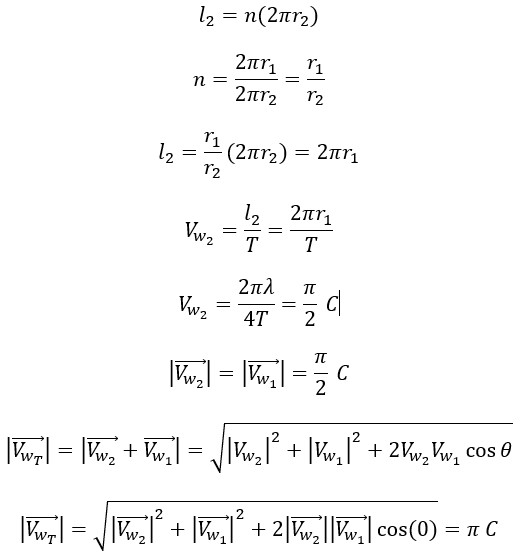
Where "l2" is the path length of a photon in small helix in one complete period of big helical motion, "n" is the number of circles of small helix during on complete circle of big one, "r1" is the radius of small helix, "Vw2" is the wave or rotational speed of a photon in small helical motion and "VwT" is the total rotational speed.
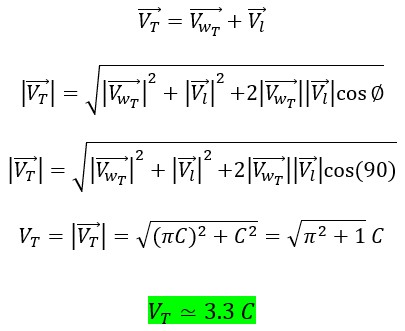
According to the figure, the total speed of a photon can be obtained from the following equations:
The total speed is equal to the sum of the speeds of a photon in two helical paths plus the linear speed
1. Analysis of the Results of the University of Michigan and MIT Experiments
In two independent experiments conducted by MIT and the University of Michigan, it was observed that, at very short distances, the experimentally measured energy of electromagnetic waves does not accord with Planck's law. According to the papers of the Saleh Research group, this discrepancy arises from the helical speed of the photon exceeding C — a matter explained in detail in the paper “ New Discoveries About the Speed of Electromagnetic Waves 2024 Part C ” of the Saleh Research Group, wherein it is shown that this equivalence is established if the speed of the photon in its nested helical motion is taken as 3.3 C.
2. The Resultant of the Electron's Motions during Photon Emission
When emitting a photon, the electron is moving at speed C around the nucleus, and is also spinning about its own axis at a very high speed. The photon emitted by this electron must carry the resultant of these speeds, namely 3.3 C, and therefore travels at a speed faster than C.
3. The Inconsistency between Planck's Relation and the Kinetic Energy of the Photon
Given that the photon possesses mass, a comparison of Planck energy with kinetic energy shows that its speed must exceed C in order for equilibrium to be established. On this basis, if the final speed of the photon is taken as:

— being the resultant of the linear motion and the two nested helical motions of the photon — the following equation:
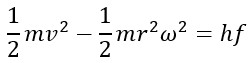
holds true for every frequency within the electromagnetic spectrum, and the relationship between the kinetic energy of the photon and Planck's formula is correctly established when rotational kinetic energy is taken into account.
4. The Existence of the High-Energy Amaterasu Particle
The observation of the high-energy Amaterasu particle, and studies into its origin and nature, represent one of the most significant challenges within the field of particle physics. Saleh Theory holds that the existence of such a particle, possessing an energy 107 times that of fundamental particles, proves that this particle — irrespective of its nature (which Saleh Theory holds, and demonstrates, to be Cidtonium) — must possess a very high speed and density, and must certainly follow a helical pattern of motion. It will therefore possess a speed faster than the speed of light, namely 3.3 C.
5. The Absence of Sinusoidal Motion in Non-Material Media
Within material media, rotational motion about a centre, occurring simultaneously with rectilinear motion, may be observed in numerous phenomena — such as the true motion of the Earth around the Sun, or the exit of a bullet from a gun barrel — yet sinusoidal motion does not occur. It therefore follows that, if the linear speed of light obtained experimentally is equal to C, and the motion is also helical (a combination of rotational and rectilinear motion), the resultant helical speed must be faster than C, namely 3.3 C.
6. The Difference in Characteristics between Red Light and Blue Light
According to wave–particle duality theory, the mass equivalent to a blue photon is assumed to be approximately twice that of a red photon, whilst, owing to its higher frequency, the energy of blue light is also considered faster than that of red light. Yet, even to visual and sensory perception, red light appears heavier, stronger and warmer than blue light. According to the Theory of Saleh, however, red light — owing to its larger radius of rotation compared with blue light — possesses faster rotational energy, and it is for this reason that the eye perceives red light as warmer and more intense than blue light. This demonstrates that the motion of light is helical, and that the helical speed is 3.3 C.
7. Direct Observation of Light from the Front
The human eye perceives light only when the light ray enters the eye from directly ahead. Furthermore, as is well known, according to wave–particle duality theory, different colors arise from variations in wavelength and frequency. If light is viewed directly from the front, a point is observed that moves up and down before the observer, and no difference can be discerned between blue and red light of differing wavelengths. In Theory of Saleh, however, the difference in the color of light arises from the difference in the radius of rotation of their respective photons. Thus, the photons of red light and blue light travelling towards the eye from directly ahead possess different radii of rotation, and the eye detects this difference in radius, perceiving it as two distinct colors. This, too, demonstrates that the motion of light is helical, and that the helical speed is consequently faster than the linear speed of light, being equal to 3.3 C.
8. The Rate of Electrical Energy Generation in Solar Cells
Experiments indicate that the rate of electrical energy generation in solar cells is directly related to the wavelength of the incident light. Accordingly, among the visible light spectra, red light exhibits faster efficiency than blue light. Yet, as noted above, according to wave–particle duality theory, red light possesses less energy than blue light. According to the Theory of Saleh, however, red photons — owing to their larger radius of rotation compared with blue photons — possess faster rotational energy, and it is therefore natural that red-light photons demonstrate better efficiency in solar cells. This proves that the motion of light is helical, and that its speed is 3.3 C.
9. The Principle of Consistency
In wave–particle duality theory, the form of wave motion considered for the motion of the photon is a sinusoidal wave; and, as is well known, a sinusoidal wave is equivalent to the shadow, or projection, of a circular (helical) motion upon a two-dimensional graph. Saleh Theory therefore possesses this principle of consistency, and, in its two-dimensional state, reduces to wave–particle duality theory. In other words, wave–particle duality theory represents a special case — an incomplete, two-dimensional view — of the larger framework of Saleh Theory. This reason, too, like those preceding it, demonstrates that the motion of light is helical.
10. The Failure to Treat Photon Mass as a Constant Value
Owing to the assumption of the non-existence of a speed faster than light, and for other reasons, scientists have been obliged to consider the mass of the photon as variable under different conditions, whereas the photon, like other particles, ought to possess a fixed and definite mass.
11. The Assumption of Two Independent Natures for the Photon in the Proposed Model
On account of scientists' failure to consider helical motion for the photon, they have been obliged to propose two natures (Wave - Particle) for the photon, whereas the photon, like other particles, possesses only one nature: a particle of fixed mass that moves helically, at a speed of 3.3 C.
12. Analysis of Young's Double-Slit Experiment
In this model, the formation of the interference pattern, even when photons or electrons are emitted individually, is interpreted as an indication of their helical motion.
The interference phenomenon observed in Young's double-slit experiment, when photons or electrons are emitted individually, can be explained and interpreted only by the helical motion of the photon (or electron), and indicates the existence of a helical speed of 3.3 C for the photon.
Conclusion
This text presents a theoretical framework for examining the possibility of the existence of speeds faster than light, and introduces the 3.3 C model as a research hypothesis. Fourteen general arguments, together with twelve arguments based on this model, provide a foundation for further study. This research seeks to demonstrate that, if this evidence is interpreted within the framework of a single unified model, the existence of a speed faster than C for the photon may be advanced and examined as an important principle — one that could bring about a fundamental revolution in fields such as astrophysics and modern physics, and even in the manufacture of electronic components.
References:
[1] Chandler, David L. “Breaking the Law, at the Nanoscale.” MIT News | Massachusetts Institute of Technology, news.mit.edu/2009/heat-0729 . Accessed 29 July 2009.
[2] Thompson, Dakotah, et al. “ Hundred-fold enhancement in far-field radiative heat transfer over the blackbody limit. ” Nature 561.7722 (2018): 216-221.
[3] Saleh, Gh. The Reform Book: A Revolution in Modern Physics. Volume Ⅱ, Saleh Research Centre, 2026, https://saleh-theory.com/files/article/pdf/the-reform-book-a-revolution-in-modern-physics-vol2-2026.pdf
[4] Saleh, Gh. “A New, Simple and Fluent Explanation for the Discovery of the New Particle Amaterasu (Cidtonium) Its Nature, Speed, Mass, Density and Other Parameters, in the Universe 2026.” Saleh Theory, 03 Aug 2026, https://saleh-theory.com/article/a-new-simple-and-fluent-explanation-for-the-discovery-of-the-new-particle-amaterasu-cidtonium-its-nature-speed-mass-density-and-other-parameters-in-the-universe-2026
[6] Saleh, Gh. “Eight Conclusive Proofs of the True Velocity of Light: Experimental, Mathematical, and Physical Evidence from Universal Observations (Vphoton = 3.3 C).” Saleh Theory, 24 Jul 2026, https://saleh-theory.com/article/eight-conclusive-proofs-of-the-true-velocity-of-light-experimental-mathematical-and-physical-evidence-from-universal-observations-vsubphotonsub-33-c
[7] Saleh, Gh. “New Discovery of Virtual Waves in the World Or A Revolution in the Manufacturing of Space Telescopes.” Saleh Theory, 07 Nov 2022, https://saleh-theory.com/article/new-discovery-of-virtual-waves-in-the-world-or-a-revolution-in-the-manufacturing-of-space-telescopes
[8] Saleh, Gh. The Reform Book: A Revolution in Modern Physics. Vol. 1, Saleh Research Centre, 2026, https://saleh-theory.com/files/article/pdf/the-reform-book-a-revolution-in-modern-physics-2026.pdf
[10] Saleh, Gh. “New Discoveries About the Speed of Electromagnetic Waves 2024 Part C.” Saleh Theory, 06 Nov 2023, https://saleh-theory.com/article/new-discoveries-about-the-speed-of-electromagnetic-waves-2024-part-c
[12] “Researchers Develop Way to Control Speed of Light, Send It Backward.” Phys.org, 4 Apr. 2019, https://phys.org/news/2019-04-researchers-develop-way-to-control.html . Accessed 4 Aug. 2026.
 Download PDF
Articles